
Design Your Dream Town
Explore the exciting world of urban planning by designing and building your very own miniature community. Discover what makes a neighborhood function well and how different parts work together to serve its residents.
The lesson goal is identify essential services and structures required for a functional community.
Learning Materials
What You Need
Missing something? Don't let it stop you. The app offers easy alternatives for every item you have at home.
Lesson Plan
- 1
Introduction
Begin by sparking curiosity about their surroundings. Encourage them to think about their own neighborhood. A **community** is a group of people living in the same place or having a particular characteristic in common. You can recognize it by the shared spaces and services people use. For example, our town is a community, but a group of friends who play together online could also be a community. The opposite might be living in complete isolation. Communities are important because they provide support and resources for people. Ask: * 'What's near our house?' * 'Where do we go for fun or food?' * 'What are some important things you see in our neighborhood?' Done when your child identifies 2-3 essential elements of a community, like houses, stores, or parks.
- 2
Explore & Plan
First, help your child gather the necessary materials: cardboard, paper, scissors, tape or glue, and a pencil or pen. Then, discuss the challenge of building a new community from scratch. Encourage brainstorming about what essential elements are needed. Ask: * 'What are the absolute must-haves for a new community?' * 'Where should everything go to make sense for the people living there?' As they come up with ideas for buildings or areas, ask: * 'Why do you think that?' Support them in sketching out their initial ideas or making a list before they begin building. Done when your child has a rough plan or list of buildings and features for their community.
- 3
Discussion
Engage your child in a discussion about their planned community. Let them explain their choices first. Ask them to consider why they chose specific buildings and areas. Introduce the idea of **interconnectedness**: how different parts of a community rely on each other. For example, a grocery store needs people from homes, and homes need the food from the grocery store. The opposite would be isolated elements that don't relate to each other. Interconnectedness is important because it makes a community function smoothly for everyone. Ask: * 'Why did you choose those specific buildings or areas for your community?' * 'How do you think a library might connect to a school, or a grocery store to the homes?' * 'What happens if you forget something really important, like a hospital?' If they get stuck, prompt deeper thinking with: 'Who uses this building?' Done when your child can explain the purpose of several chosen community elements and their connections to each other.
- 4
Activity
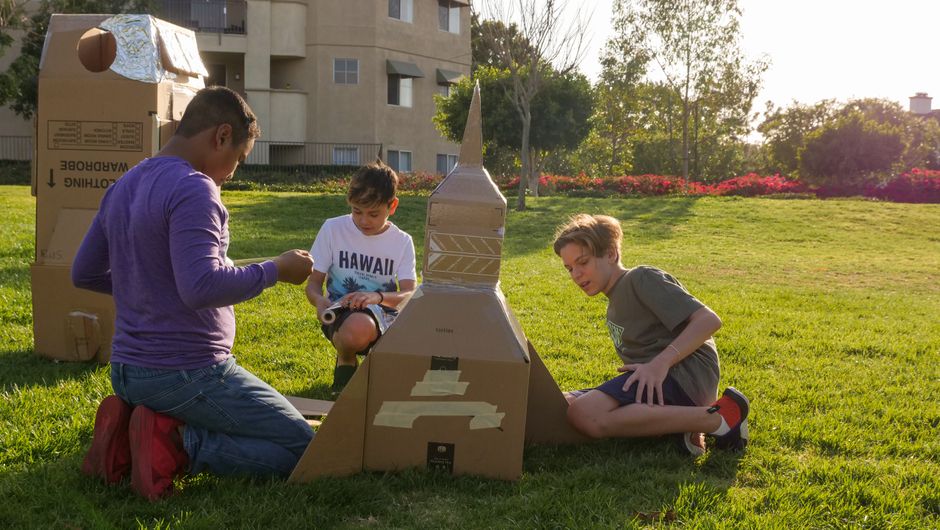
Now it's time to bring their plan to life! Supervise your child's use of scissors carefully. Guide them to use the cardboard, paper, scissors, and tape or glue to construct simple 3D models of their buildings. They should then lay out these elements on a larger piece of cardboard or paper to create their community model. Encourage creativity and problem-solving as they build. Remind them that the goal is to make their ideas real, not necessarily to create perfect craftsmanship. Offer to help cut any tougher cardboard if needed, but allow your child to lead the designing and placing of elements. Ask: * 'How will you make sure people can easily get from one place to another?' Done when your child has constructed a physical model of their community with multiple elements, such as houses, schools, and parks.
- 5
Summary
Celebrate your child's effort and the community they've built! Connect their model back to real-world towns and cities. Ask: * 'What was the most challenging part of designing your community?' * 'What's one thing you learned today about how communities are planned?' * 'What's one thing you learned today about why communities are so important for everyone?' * 'What might you do differently next time, or what surprised you?' Done when your child shares at least one key takeaway or a reflection on their design process.