Thanksgiving Sparks Pack: 5 Sparks full of food, history and thanks
How to Use This Pack
Five Thanksgiving Sparks to explore at home, each ready to go with simple steps and a printable page. Most use things you already have in the kitchen.
| Spark | Subject | Time | |
|---|---|---|---|
| 1 | The Three Sisters Garden | Science | 30 min |
| 2 | Double the Turkey, Double the Time? | Math | 30 min |
| 3 | Ben Franklin's Favorite Bird | Science | 30 min |
| 4 | The Woman Who Gave Us Thanksgiving | Language Arts | 30 min |
| 5 | Keeping the Harvest | Science | 30 min |
How Each Spark Works
- Read first: Take five minutes to read the Spark and gather what you need.
- Read the comic: Three Sparks come with a comic page. Read it together before Stage 1, or hand it to your child on its own to read and color.
- Follow the stages: Each stage has a time, what to do and Know Before You Teach: what to say, what to expect and how to make it easier or harder.
- Look for Done when: The blue bar tells you when your child is ready to move on.
- Finish with the quiz: Four questions, each with a Parent Tip to guide your child without giving the answer away.
Kid pages and comics: every Spark has a printable kid page, and three have a comic, right after it. Print the Sparks you need, or the whole pack.

Spark 1 of 5
The Three Sisters Garden
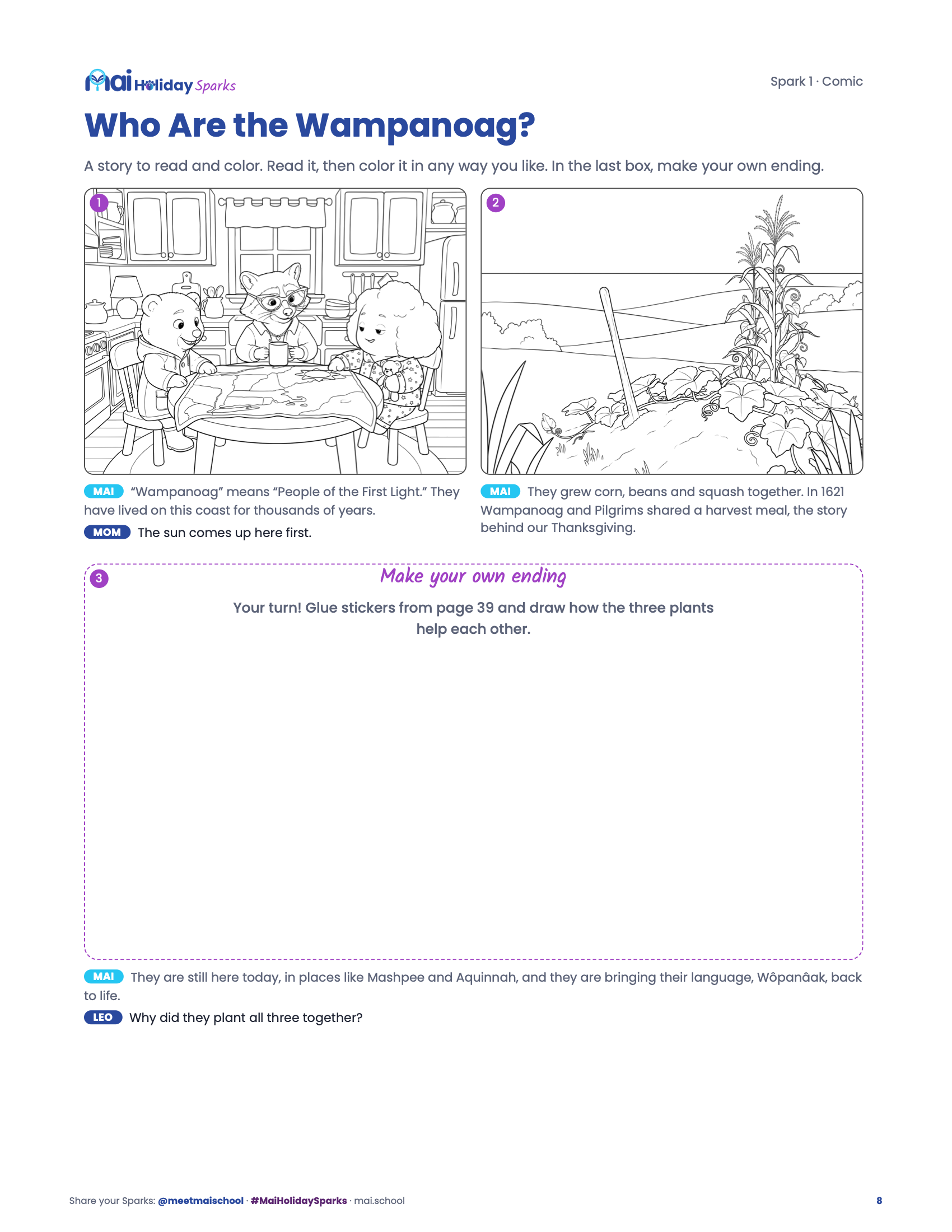
Discover the Three Sisters Garden, where corn, beans and squash grow together as a team. This Spark opens with the comic "Who Are the Wampanoag?" and explores how the three plants help each other, a way of farming the Wampanoag have used for generations. Then it connects the garden to the Thanksgiving harvest.
Our goal: Learners will understand how corn, beans and squash work together in a symbiotic relationship, identifying the unique benefits each plant provides. They will be able to create their own model garden and connect this ancient gardening method to the Thanksgiving harvest.
What You Need
Dried corn kernels • Dried beans • Squash seeds • Small cup or pot • Potting soil • Small tray or plate • Large paper cutouts of the three plants • Worksheet • Pencils or markers • Watering can or cup
After this Spark: comic, kid page, stickers.
Learning Guide
A simple guide to lead you through the kickoff, the core challenge, and everything in between.
Mai’s Tips
- Safety first: Dried beans, kernels and seeds are a choking risk for little kids. A grown-up stays close, and nothing goes in mouths. Raw dried beans are not safe to eat.
- Mind Trap: Children might initially think plants compete for resources. This Spark directly challenges that by showing cooperation. Let them voice those competitive ideas first; don't correct until you're ready to explain symbiosis in Stage 3.
- Simplification: For younger children (4-6), focus on the three sisters helping each other. Let them place the paper cutouts and draw what each plant does instead of writing.
- Depth: For older children (7-12), encourage them to research the scientific terms (e.g., nitrogen fixation for beans) and the historical significance of the Three Sisters beyond just the Wampanoag to other Indigenous groups.
- Real-world connection: When looking for Three Sisters foods on the Thanksgiving table, prompt beyond just 'corn on the cob.' Think of cornbread, succotash (corn and beans), pumpkin pie, roasted squash or even green bean casserole for beans.
Prep Before Session 5 min
- Gather corn kernels, dried beans and squash seeds.
- Cut out large paper shapes of a corn plant, a bean plant and a squash plant for little kids.
- Print the Three Sisters worksheet (or have plain paper and drawing supplies ready).
1Introduction 5 min
Read the comic together: "Who Are the Wampanoag?" Then ask the big question: "Hundreds of years ago, farmers in what is now Massachusetts planted corn, beans and squash in one small hill. Why?" Listen to every idea without correcting it. Their guesses show you how they think right now.
Know Before You Teach
- Good to know: The Wampanoag have lived in what is now Massachusetts and Rhode Island for thousands of years, and still do.
- The Three Sisters Garden was a traditional, sustainable farming method practiced by many Indigenous cultures, including the Wampanoag.
- If they ask: What is Thanksgiving? Thanksgiving is a holiday in the United States and Canada that celebrates harvest and other blessings of the past year. It's often associated with a historical feast shared between Pilgrims and Wampanoag people.
- Key words: Wampanoag: The Wampanoag have lived in what is now Massachusetts and Rhode Island for thousands of years, and still do.
- Key words: harvest: Gathering crops when they are ripe and ready to eat.
- It's working when: Child expressing curiosity about how plants grow or the history of farming.
- If they're stuck: Shift the focus to what plants need to grow in general: 'What do you think any plant needs to be healthy?'
- Easier: Show the three kinds of seeds and ask: "Could these three plants be friends?"
- Harder: Ask them to imagine challenges early farmers faced and how they might solve them with only natural resources.
Done when: Child offers an initial theory or hypothesis about why the three plants might be grown together.

2Explore & Plan 8 min
Lay out the corn, bean and squash 'seeds' (kernels, dried beans). Discuss what each plant needs to thrive individually, then ask them to predict how they might interact when planted closely. This sets up the problem before you give the solution.
Know Before You Teach
- Good to know: Beans are vining plants that need something to climb.
- Squash plants have large leaves and spread widely on the ground.
- If they ask: Do all beans climb? Most garden beans, especially the ones called 'pole beans,' love to climb! Bush beans are a different kind that stay small and don't need a pole.
- It's working when: Child making connections between a plant's physical characteristics and its needs (e.g., 'corn is tall, so it needs to stand up').
- If they're stuck: Suggest drawing each plant individually first and listing its needs next to it.
- Easier: Focus on very basic needs: 'Does it like sun or shade? Does it need something to hold onto?'
- Harder: Ask them to design a small garden plan for each plant growing alone, then together, noting the space each would take.
Done when: Child describes basic needs for each plant type and makes a prediction about their interaction when planted together.
3Discussion 6 min
This is where the core concept is explained. Introduce the term symbiosis as living together for mutual benefit. Clearly explain how corn provides support, beans enrich the soil and squash protects the ground. Then, guide them to apply this new understanding.
Know Before You Teach
- Good to know: Symbiosis is a close, long-term interaction between two different biological organisms.
- Corn provides a physical structure (stalk) for beans to climb, giving them access to sunlight.
- Beans are legumes; they have bacteria in their root nodules that convert atmospheric nitrogen into a form plants can use, enriching the soil.
- If they ask: What does 'nutrients' mean? Nutrients are like food for plants, things they absorb from the soil to help them grow strong, just like we need vitamins and minerals.
- Key words: symbiosis: When different living things live together and help each other.
- Key words: nutrients: Special things in the soil that plants 'eat' to grow healthy.
- It's working when: Child expressing 'aha!' moments as they understand the interlocking benefits.
- If they're stuck: Use a simple human analogy: 'Imagine you need to reach a high shelf, and your friend gives you a boost. That's a bit like how the corn helps the beans!'
- Easier: Focus on the 'who helps whom' aspect: 'Who is the climbing helper? Who is the soil feeder? Who is the ground protector?'
- Harder: Ask them to explain 'nitrogen fixation' in their own words after a brief, simple explanation from you.
Done when: Child can explain the role of each 'sister' plant and understand the concept of symbiosis.
4Planting the Garden 9 min
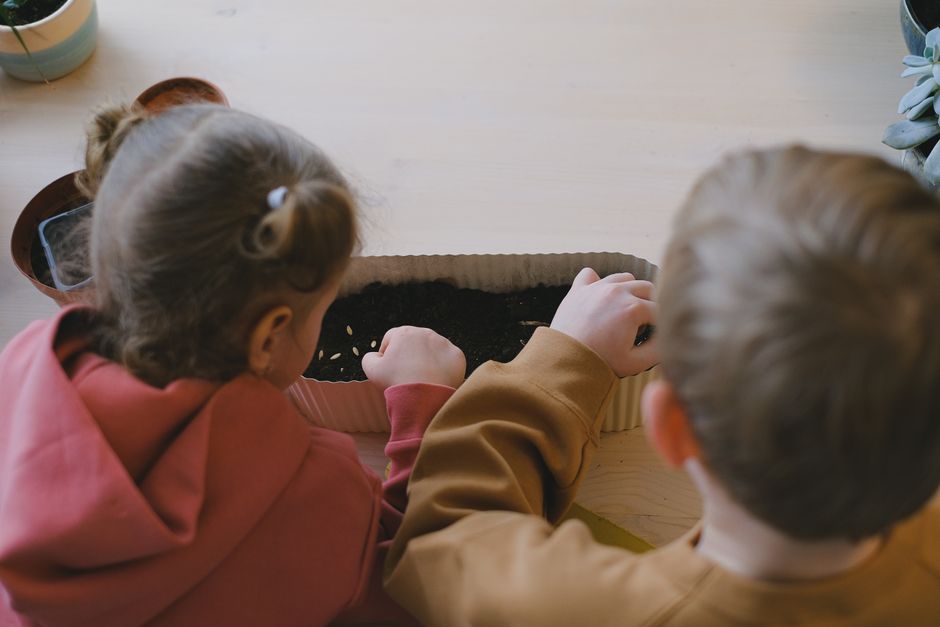
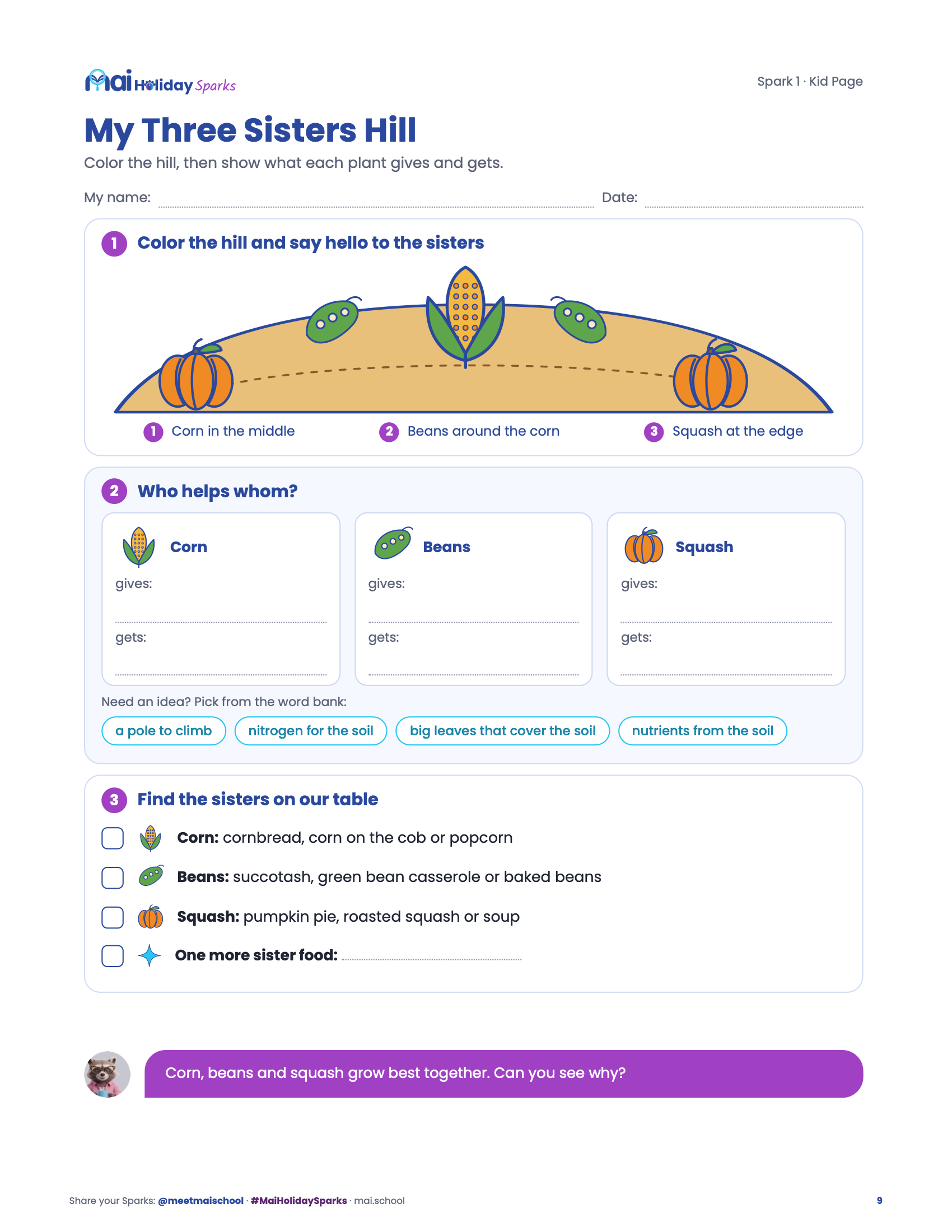
Build a model Three Sisters hill on a plate or tray. This is the main activity. Planting real seeds in a cup is optional. Place the plants in the order the Wampanoag did: corn first, in the middle. They added the beans and squash once the corn was about as tall as a hand. So put the beans around the corn, then the squash around the edge. Then use the worksheet (or plain paper) to show what each plant gives and gets.
Know Before You Teach
- Good to know: The Wampanoag planted corn first. Once the corn was about as tall as a hand, they planted the beans and squash around its base.
- As the corn grew, the beans climbed and wound around the corn stalks.
- If they ask: Will these seeds really grow? If they're viable seeds and get enough sun and water, yes! But even if they don't, we've learned a lot about how they would work together if they did.
- It's working when: Child intentionally placing seeds based on the roles learned in the previous stage.
- If they're stuck: Demonstrate with one set of seeds how the placement works, then have them finish.
- Easier: Use the large paper cutouts of the three plants instead of small seeds, and place them on the model hill together.
- Harder: Challenge them to explain why each plant needs to be in its specific location as they place it.
Done when: Seeds or cutouts are placed in the right spots, and the worksheet shows what each plant gives and gets.

5Harvesting Connections 2 min
Reflect on the learning. Connect the Three Sisters to Thanksgiving traditions and the idea of gratitude for nature's gifts. This helps solidify the real-world relevance of their discovery.
Know Before You Teach
- Good to know: The Three Sisters Garden is a symbol of sustainability, cooperation and gratitude for the earth's bounty.
- If they ask: Are there other foods that grow together? Yes! Many cultures have companion planting traditions, like basil with tomatoes or marigolds to deter pests around vegetables.
- It's working when: Child enthusiastically identifying Thanksgiving foods and linking them to the Spark.
- If they're stuck: Start naming Thanksgiving foods and ask, 'Is this a sister? Which one?'
- Harder: Ask them to think about how modern farming might be different if more farms used Three Sisters principles.
Done when: Child can identify one key learning point and can name at least one Thanksgiving food related to the Three Sisters.
Beyond The Spark
Fuel their curiosity beyond the Spark with bonus extras.
Table Talk
Farmers and gardeners around the world use the principles of companion planting to grow healthier food, reduce pests and improve soil without as many chemicals.
Did You Know?
Bean plants have tiny bacteria on their roots that help make food for the soil.
Challenge
Research another example of intercropping or companion planting used by different cultures around the world. How do they work together?
Quick Recap Quiz 4 min
Customize this quiz, add questions, or follow your child's lead! Each question has a 'Parent Tip' to help them find the answer without giving it away.
1. What does the corn plant provide for the beans in a Three Sisters Garden?
- Nutrients for the soil
- A climbing pole
Think about how the bean plant grows as it gets taller.
2. How do the beans help the other plants in the Three Sisters Garden?
- They add nutrients to the soil
- They scare away hungry animals
Look back at Stage 3. What did each sister do for the others?
3. What is the squash plant's main job in the Three Sisters Garden?
- It gives the beans a pole to climb
- Its big leaves cover the ground, keeping weeds out and water in
Look at the shape of a squash plant and how its leaves spread out.
4. The way the Three Sisters plants help each other is an example of...
- Symbiosis
- Competition
Look back at the new word from Stage 3.
Spark 2 of 5
Double the Turkey, Double the Time?
This Spark challenges families to think like chefs and scientists, exploring how recipes change when scaled up or down for a Thanksgiving feast. Children will discover that not everything doubles just because the main ingredient does, learning about proportional and non-proportional relationships in a fun, hands-on way.
Our goal: Learners will understand that scaling recipes isn't just about doubling everything; some things change proportionally while others don't. They will be able to predict how various cooking elements, like ingredients, pan size and cooking time, are affected when adjusting a recipe, applying math to real-world cooking challenges.
What You Need
Simple family recipe • Pen or pencil • Worksheet or plain paper • Turkey roasting chart
After this Spark: kid page.
Learning Guide
A simple guide to lead you through the kickoff, the core challenge, and everything in between.
Mai’s Tips
- Safety first: A chart is a guide. A turkey is safe to eat when a thermometer in the thickest part reads 165°F. Kids stay back from the hot oven.
- Proportionality: The core of this Spark is understanding that while ingredients often scale proportionally (double the servings, double the flour), factors like cooking time and pan size follow more complex, non-proportional rules. This teaches flexible thinking beyond simple multiplication.
- Real-world Math: This activity grounds abstract math concepts (ratios, scaling) in a very tangible, relatable context: food. Children see immediate, practical applications, which boosts engagement and retention more than textbook problems.
- Simplifying: If the chosen recipe is too complex for calculations, simplify by focusing on just 2-3 key ingredients. For younger children, you can just discuss 'more' or 'less' instead of exact x2/1/2 calculations, and focus on the turkey chart discovery.
- Chart Nuance: Turkey roasting charts provide estimates. Point out that factors like whether the turkey is stuffed, oven calibration and starting temperature also influence cooking time, making it an art as much as a science. This highlights that real-world math isn't always perfectly precise.
1Introduction: The Turkey Mystery 5 min
Open the Spark by posing the big question to spark curiosity. Encourage any prediction – there's no wrong answer here, just thinking. You're setting the stage for discovery.
Know Before You Teach
- Good to know: Thanksgiving turkeys are traditionally roasted whole, which means heat has to travel from the outside to the very center of the bird.
- It's working when: Child shows curiosity and engages with the 'why' behind the question, even if their initial guess is simple.
- If they're stuck: Ask what happens if they try to cook a very tiny piece of chicken vs. a whole chicken – does the whole chicken just cook for a few more minutes, or much longer?
- Easier: Focus just on their initial guess and the simple concept of 'longer' or 'shorter' time.
- Harder: Ask them to consider why they think it might or might not double – what physical properties of the turkey or cooking process might change?
Done when: Student engages with the question and offers an initial prediction about turkey cooking time.

2Explore & Plan: Our Recipe Challenge 8 min
Have your child select a simple recipe they know. Guide them to think about how ingredients change when scaling a recipe. Ask questions to get them predicting.
Know Before You Teach
- Good to know: Recipes are often designed for a specific number of servings, and scaling them means adjusting all ingredients proportionally.
- Choosing a simple recipe makes it easier to focus on the scaling math without getting bogged down by complex instructions or many ingredients.
- If they ask: Can I pick any recipe? Yes, but let's pick one with clear ingredient amounts, like '2 cups flour' or '1/2 teaspoon salt', to make the math easier for our chart.
- It's working when: Child easily identifies ingredients and understands the basic idea of 'more' or 'less' for different serving sizes.
- If they're stuck: Suggest a very simple recipe like making lemonade (water, sugar, lemon juice) and ask how they'd make twice as much.
- Easier: Just focus on one or two main ingredients from the recipe and discuss how those would change.
- Harder: Ask them to consider if there are any ingredients that you might NOT want to exactly double, even if you double the recipe (e.g., very strong spices, very specific leavening agents).
Done when: Student has chosen a recipe and identified some ingredients they would change for different serving sizes.

3Discussion: Proportional or Not? 6 min
Explain that some things change evenly when you scale a recipe (proportional) and some don't (non-proportional). Then look at the turkey roasting chart together. A 10 lb turkey takes about 3 hours. A 20 lb turkey takes about 4.5 hours. Twice the weight, about one and a half times the time.
Know Before You Teach
- Good to know: Proportional relationships mean that as one quantity increases or decreases, another quantity changes by the same factor (e.g., double the input, double the output).
- On the USDA roasting chart (unstuffed turkey, oven at 325°F), 8 to 12 lb takes 2¾ to 3 hours and 18 to 20 lb takes 4¼ to 4½ hours. So 10 lb is about 3 hours and 20 lb is about 4.5 hours.
- Heat travels from the outside of the turkey to the middle, so the thickness matters more than the weight.
- If they ask: Why doesn't the time double if the turkey doubles? Heat travels in from the outside to the middle. A turkey that weighs twice as much isn't twice as thick, only about a quarter thicker, so the heat's trip to the middle is only a little longer. That's why the time goes up, but not double.
- Key words: Proportional: When things change in the same way, like if you double your cookies, you double the flour.
- Key words: Non-proportional: When things change, but not in the same way, like a bigger turkey takes longer to cook, but not exactly twice as long.
- It's working when: Child grasps the difference between proportional and non-proportional, especially when comparing ingredient scaling to turkey cooking time.
- If they're stuck: Picture two puddles, one twice as deep. It holds twice the water. Is it twice as wide too? Then look at the chart again.
- Easier: Focus on the turkey example: just point out that the chart shows it's not double the time, without using the terms 'proportional' or 'non-proportional'.
- Harder: Discuss what other factors might influence the turkey cooking time besides weight (e.g., oven temperature, starting temperature of the turkey, if it's stuffed).
Done when: Student can name one thing that changes proportionally in a recipe and has found the 10 lb and 20 lb times on the turkey chart.

4Activity: The 'Does It Double?' Chart 9 min
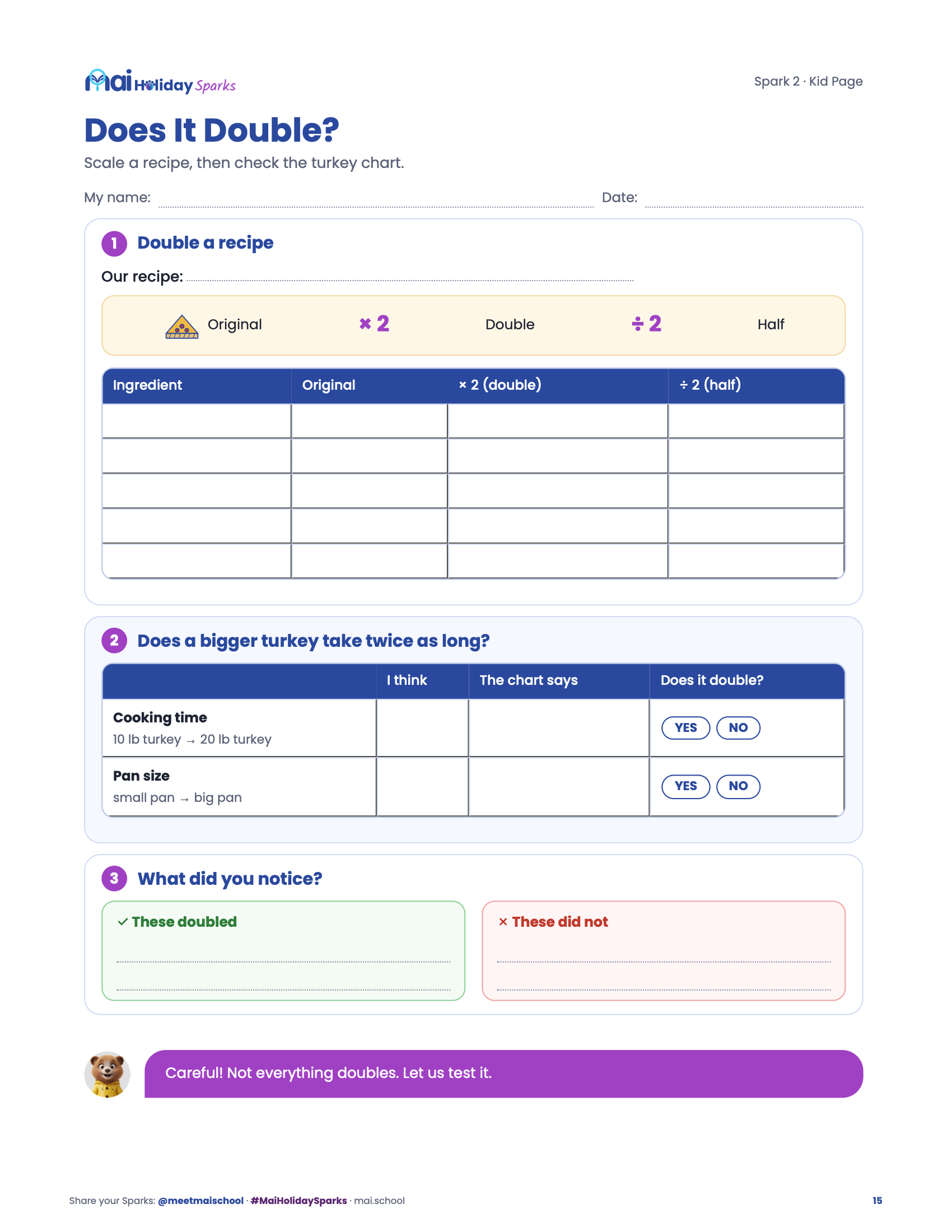
Guide your child through filling out the chart. First they scale the recipe's ingredients, then they use the turkey chart to compare cooking times. Pan size is an optional extra question.
Know Before You Teach
- Good to know: A roasting chart gives a time range for each group of weights, for example 2¾ to 3 hours for an 8 to 12 lb turkey.
- If they ask: What if my recipe doesn't have pan size? That's okay! We can just think about it. If you have a very big turkey, would it fit in the same small pan or would you need a bigger one? And would it need a pan that's exactly twice as big?
- If they're stuck: For calculations, use a calculator or offer simplified numbers. For the chart, help them find the correct row/column for different turkey weights.
- Easier: Fill in the 'Original' and 'x2' columns together, and just focus on comparing the cooking times for two different turkey weights from the chart.
- Harder: Draw time against weight. Is it a straight line?
Done when: Student has filled in the 'Does it double?' chart with the scaled ingredients and the cooking times for two turkey weights from the roasting chart.

5Summary: Kitchen Discoveries 2 min
Wrap up the Spark by celebrating their learning. Ask reflection questions to help them solidify what they've learned and connect it to future cooking experiences.
Know Before You Teach
- Good to know: Reflecting on discoveries helps solidify learning and connect new concepts to existing knowledge.
- Understanding kitchen math builds confidence and practical life skills.
- If they ask: What if I get it wrong when cooking? That's how we learn! Even experienced chefs make adjustments. The more you understand these ideas, the better you'll get at predicting and making good guesses in the kitchen.
- It's working when: Child articulates a specific surprise or learning point, showing they engaged with the core concept.
- If they're stuck: Prompt them with 'What was the most surprising number you saw on the turkey chart?' or 'What ingredient did you enjoy scaling the most?'
- Easier: Simply ask what was 'cool' or 'interesting' about the activity.
- Harder: Ask how this kind of thinking (about things scaling differently) might be useful outside of cooking, like building a LEGO castle or planning a party.
Done when: Student shares one key takeaway or a surprising fact they learned.
Beyond The Spark
Fuel their curiosity beyond the Spark with bonus extras.
Table Talk
Understanding proportional and non-proportional relationships helps chefs plan for large events, engineers design structures and even scientists analyze data.
Did You Know?
A turkey that weighs twice as much is only about a quarter thicker. Heat has to travel through the thickness, so the cooking time goes up much less than double.
Challenge
What other kitchen items or activities might scale non-proportionally? (e.g., the number of people washing dishes vs. time, or the amount of spice in a dish vs. portion size). Can you think of an ingredient that you absolutely would NOT double just because you doubled the recipe?
Quick Recap Quiz 4 min
Customize this quiz, add questions, or follow your child's lead! Each question has a 'Parent Tip' to help them find the answer without giving it away.
1. If you double a cake recipe, what generally happens to the amount of flour you need?
- It stays the same.
- It doubles.
Look at the x2 column on your chart.
2. If you cook a turkey that is twice as heavy, will it cook in exactly double the time?
- No, it takes longer but not exactly double.
- Yes, it takes exactly double the time.
Look at the 10 lb and 20 lb rows on the turkey chart.
3. Which of these is most likely a 'proportional' change in a recipe?
- How much oven space you need.
- The cups of potatoes for mashed potatoes.
Which of these would you write in the x2 column of your chart?
4. Why is it important to know that not everything doubles in cooking?
- To avoid overcooking or using too much of certain ingredients.
- So you can use the same pan for any size meal.
Think about the turkey chart. What would happen if you just doubled the time?

Spark 3 of 5
Ben Franklin's Favorite Bird
Explore the famous (and often misunderstood) story of Benjamin Franklin's thoughts on the turkey as America's national bird. We'll read his own words, compare them to the real wild turkey and critically think about what makes a good national symbol.
Our goal: Learners will understand how to analyze historical writings to discover past viewpoints and distinguish between popular myths and scientific facts about animals. They will also be able to form and support their own opinions about what qualities make an effective national symbol.
What You Need
Printable worksheet • Pencils • Crayons or colored pencils • Small pieces of paper
After this Spark: comic, kid page, stickers.
Learning Guide
A simple guide to lead you through the kickoff, the core challenge, and everything in between.
Mai’s Tips
- Challenging assumptions: This Spark is designed to make children question commonly held 'facts.' Don't rush to correct their initial ideas; let them explore Franklin's letter and the turkey facts first to discover the truth themselves.
- The 'why' matters: The core of this Spark isn't just knowing the facts about Franklin, but understanding why folklore persists and how to verify information. If they're just memorizing, ask 'How do you know that?' or 'What made you change your mind?'
- Simplifying for younger children: For 4-6 year olds, focus on the fun parts of the turkey (wattle, snood) and the speed comparison (fast or slow?). You can skip the detailed 'fact vs. folklore' discussion and simply state, 'Many people think Franklin wanted the turkey, but he just admired it a lot!'
- Deepening for older children: For 10-12 year olds, discuss why a country chooses a national symbol. What does the Bald Eagle represent? Does the turkey represent similar or different values? Encourage them to consider the historical context of Franklin's letter – what was happening in America in 1784?
1A Famous Question 5 min
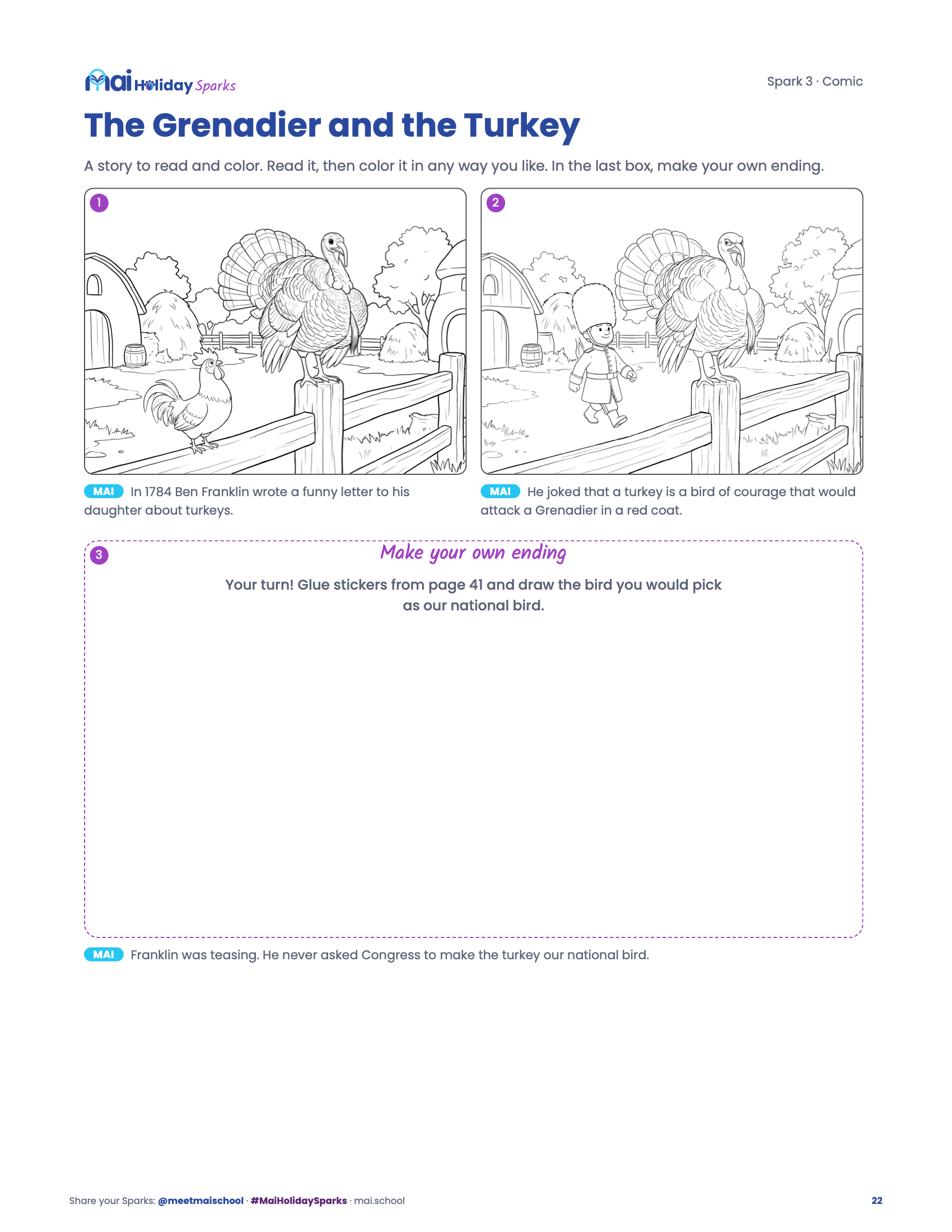
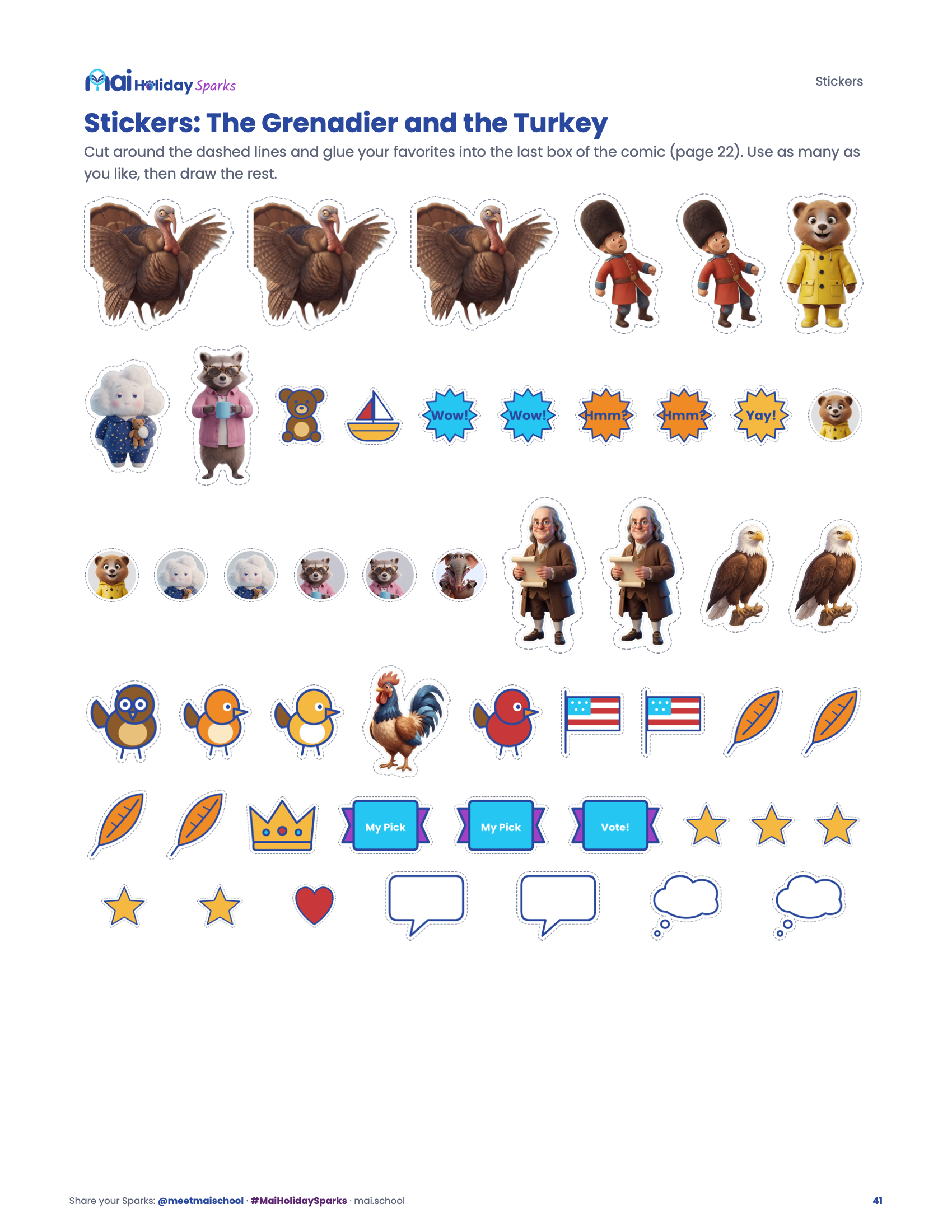
Read the comic together: "The Grenadier and the Turkey." Then ask the big question: "Did Ben Franklin really want the turkey to be America's national bird?" Explain that people tell this story every Thanksgiving, and today you will find out if it's true. Hear their ideas without correcting them yet.
Know Before You Teach
- Good to know: The story of Ben Franklin wanting the turkey as the national bird is widely known but often misunderstood.
- Franklin's preference for the turkey was expressed in a private letter, not a formal proposal.
- If they ask: Did Benjamin Franklin hate the bald eagle? He criticized the eagle in his letter, calling it 'a Bird of bad moral Character' because it steals fish from other birds.
- It's working when: The child expressing an opinion, even if it's based on common knowledge.
- If they're stuck: If they're hesitant, share your own initial thoughts on the story before learning the facts.
- Easier: For younger children, simply ask if they've heard this story before.
- Harder: Ask older children to consider why this particular story might have become so popular.
Done when: Student engages with the question and shares initial thoughts or prior knowledge.

2Explore Franklin's Words 8 min
Franklin wrote these words in a letter to his daughter, Sarah Bache, on 26 January 1784. The letter was about the badge of the Society of the Cincinnati, a club for officers who fought in the American Revolution. Franklin thought the eagle on the badge looked more like a turkey. Read this part of the letter aloud:
"For my own part I wish the Bald Eagle had not been chosen as the Representative of our Country. He is a Bird of bad moral Character. ... For in Truth the Turkey is in Comparison a much more respectable Bird, and withal a true original Native of America. ... He is besides, tho’ a little vain and silly, a Bird of Courage, and would not hesitate to attack a Grenadier of the British Guards who should presume to invade his Farm Yard with a red Coat on."
Then ask what words Franklin used for the turkey, and whether he sounds like he wants it as the national bird or just likes it better than the eagle. For ages 4 to 6, don't read the whole quote. Ask only about three words: "courage," "respectable" and "native."
Know Before You Teach
- Good to know: The excerpt is from a letter Franklin wrote to his daughter, Sarah Bache, on 26 January 1784.
- The letter was about the badge of the Society of the Cincinnati, a club for officers who fought in the American Revolution. Franklin thought the eagle on the badge looked more like a turkey.
- He praised the turkey's courage and its American origins, and criticized the eagle for stealing fish.
- If they ask: What's a Grenadier? A Grenadier was a soldier, often very tall and imposing, who carried grenades. Franklin was making a funny point about the turkey's bravery against even the scariest opponent.
- It's working when: The child identifying specific descriptive words Franklin used, e.g., 'courage,' 'respectable,' 'vain and silly.'
- If they're stuck: Re-read a particularly descriptive line and ask, 'What image does that put in your head?'
- Easier: Don't read the whole quote. Ask only about three words, "courage," "respectable" and "native": are those good things for a bird to be?
- Harder: Ask: 'Do you think Franklin was being completely serious here, or was he being a bit sarcastic or playful?'
Done when: Student listens to the excerpt and identifies at least one descriptive word or phrase Franklin uses for the turkey.

3Fact vs. Folklore 6 min
Teach the concept of fact vs. folklore. Fact: something proven true with evidence. Folklore: a traditional story or belief, often passed down, not necessarily proven. Discuss how to tell them apart. After discussion, confirm the factual history.
Know Before You Teach
- Good to know: Folklore: A traditional belief, custom or story passed down through generations, often without clear proof.
- Franklin's letter was a personal opinion, not an official act, which is key to understanding the 'folklore' part of the story.
- The bald eagle became the official national bird only in December 2024, when Congress passed a law and the President signed it.
- If they ask: Is all folklore fake? No, folklore often contains wisdom or cultural truths, even if the specific story isn't historically proven. It's about what people believe and share.
- Key words: Fact: Something that is real and can be proven.
- Key words: Folklore: A popular story or belief, often old, that people pass around.
- It's working when: The child offering examples from their own experience (e.g., Santa Claus for folklore, the sun rising for a fact).
- If they're stuck: Provide a simple example: 'Is it a fact that it's sunny today, or is that just folklore?'
- Easier: Focus on very clear examples of fact (e.g., 'I am wearing shoes') versus folklore (e.g., 'If you make a funny face, it will stay that way').
- Harder: Ask: 'Why do you think certain folklore stories, like the one about Franklin and the turkey, become so popular and widely believed?'
Done when: Student understands the difference between fact and folklore and can give an example of each (even if it's not related to the turkey).

4Meet the Real Turkey 9 min
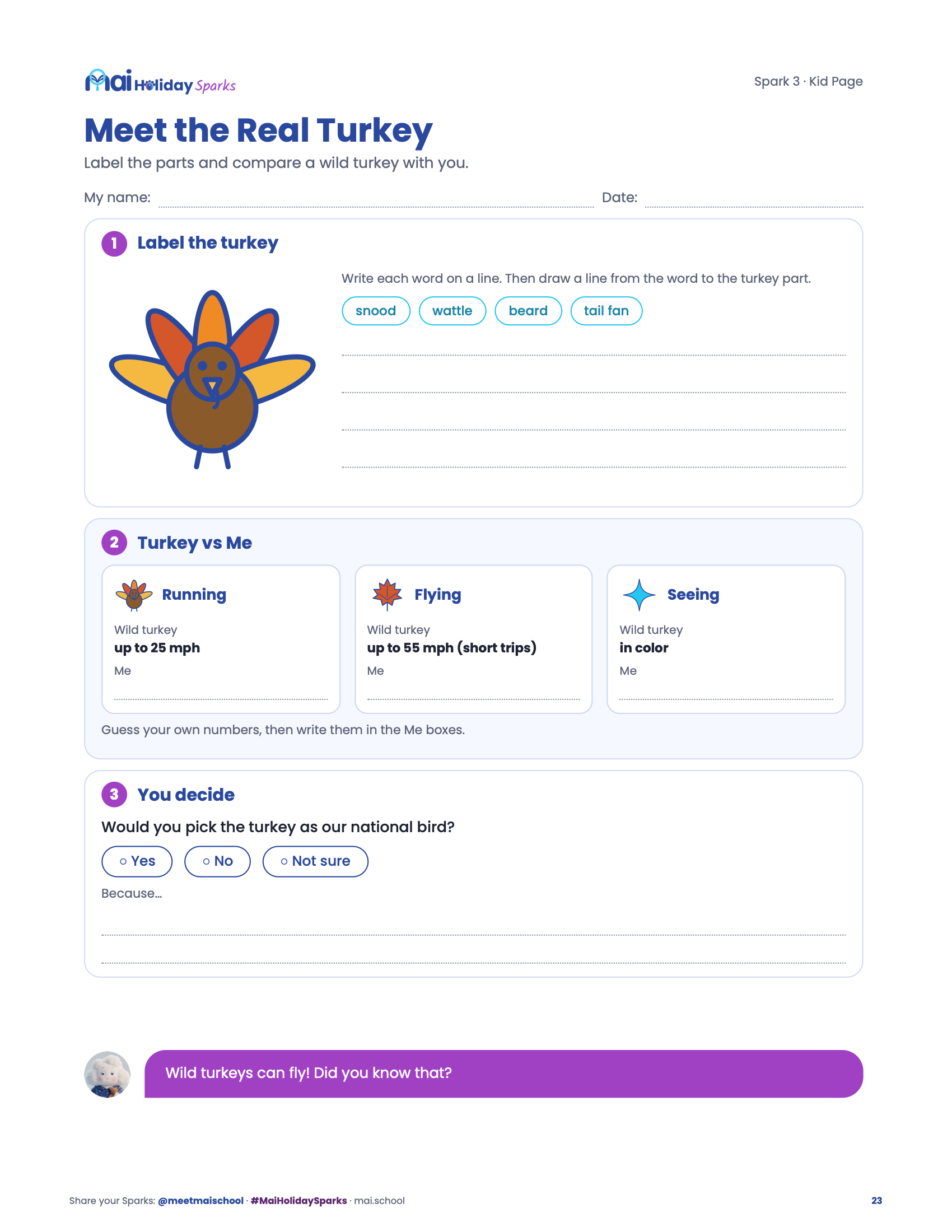
Have your child use the worksheet (or plain paper) to label the turkey's parts and fill in the 'Turkey vs. Me' chart. Share these facts as they work: wild turkeys can run up to 25 mph, fly short distances at up to 55 mph and see in color.
Know Before You Teach
- Good to know: Wild turkeys are much more capable than many people think. A grown male can run at 25 mph and fly at 55 mph for short distances.
- Snood: A fleshy appendage that hangs over the turkey's beak. It changes size and color depending on the turkey's mood.
- If they ask: Do all turkeys have beards? Mostly male turkeys have beards, but some females can have them too! It's less common for hens to grow a beard.
- Key words: Wattle: The red, bumpy skin on a turkey's neck and chin.
- Key words: Beard: A tuft of stiff feathers that hangs from a turkey's chest.
- Key words: Tail fan: The big, fanned-out feathers at the back of a turkey.
- It's working when: The child showing surprise or interest in the turkey facts, especially about its abilities.
- If they're stuck: Focus on just one part to label or one ability to compare, then move on.
- Easier: Help label 1-2 parts and just talk about whether the turkey is fast or slow, and if it can fly.
- Harder: Ask: 'Knowing these facts, do you think Benjamin Franklin's description of the turkey as a 'bird of courage' is still fitting?'
Done when: Student has completed labeling and the 'Turkey vs. Me' chart, and has a better understanding of wild turkey abilities.

5Our National Symbol 2 min
Facilitate a reflection on national symbols and their personal preferences. Encourage thoughtful discussion and justification of their choices.
Know Before You Teach
- Good to know: National symbols often represent a country's values, history or unique characteristics.
- Choosing a symbol involves considering what qualities are important to represent.
- If they ask: Why did they pick the bald eagle, then? The bald eagle went on the Great Seal of the United States in 1782, as a sign of strength and freedom. But it only became the official national bird in December 2024, when Congress passed a law and the President signed it.
- It's working when: The child explaining their choice with a reason linked to values or characteristics.
- If they're stuck: Prompt with some ideas: 'Should it be strong? Beautiful? Unique to America? Something else?'
- Easier: Just ask what their favorite animal is and why they like it.
- Harder: Ask them to imagine arguing for their chosen national animal to a committee. What would be their strongest points?
Done when: Student shares their opinion on important qualities for a national symbol and chooses a national animal with a reason.
Beyond The Spark
Fuel their curiosity beyond the Spark with bonus extras.
Table Talk
Learning to distinguish fact from folklore helps us understand history and current events more clearly, making us better thinkers and decision-makers.
Did You Know?
In the same letter, Franklin wrote that the first turkeys seen in Europe were served at a French king's wedding.
Challenge
Research the national animals or symbols of three other countries. What do they represent, and why do you think those animals were chosen?
Quick Recap Quiz 4 min
Customize this quiz, add questions, or follow your child's lead! Each question has a 'Parent Tip' to help them find the answer without giving it away.
1. Did Ben Franklin formally propose the turkey as the national bird to Congress?
- Yes, he gave a speech to Congress about it.
- No, he only expressed a personal preference.
Think about where Franklin wrote his words about the turkey.
2. What is the difference between a fact and folklore?
- A fact is proven true; folklore is a traditional story.
- A fact is written in a book; folklore is told out loud.
Look back at the two new words from Stage 3.
3. Which of these is true about a wild turkey?
- They can run fast, but cannot fly.
- They can fly short distances, run fast and see in color.
Look back at the 'Turkey vs. Me' chart.
4. Why is it helpful to learn the difference between fact and folklore?
- It helps us think critically and understand history better.
- It helps us win arguments with friends.
Encourage them to think about how this skill applies beyond just turkeys.
Spark 4 of 5
The Woman Who Gave Us Thanksgiving
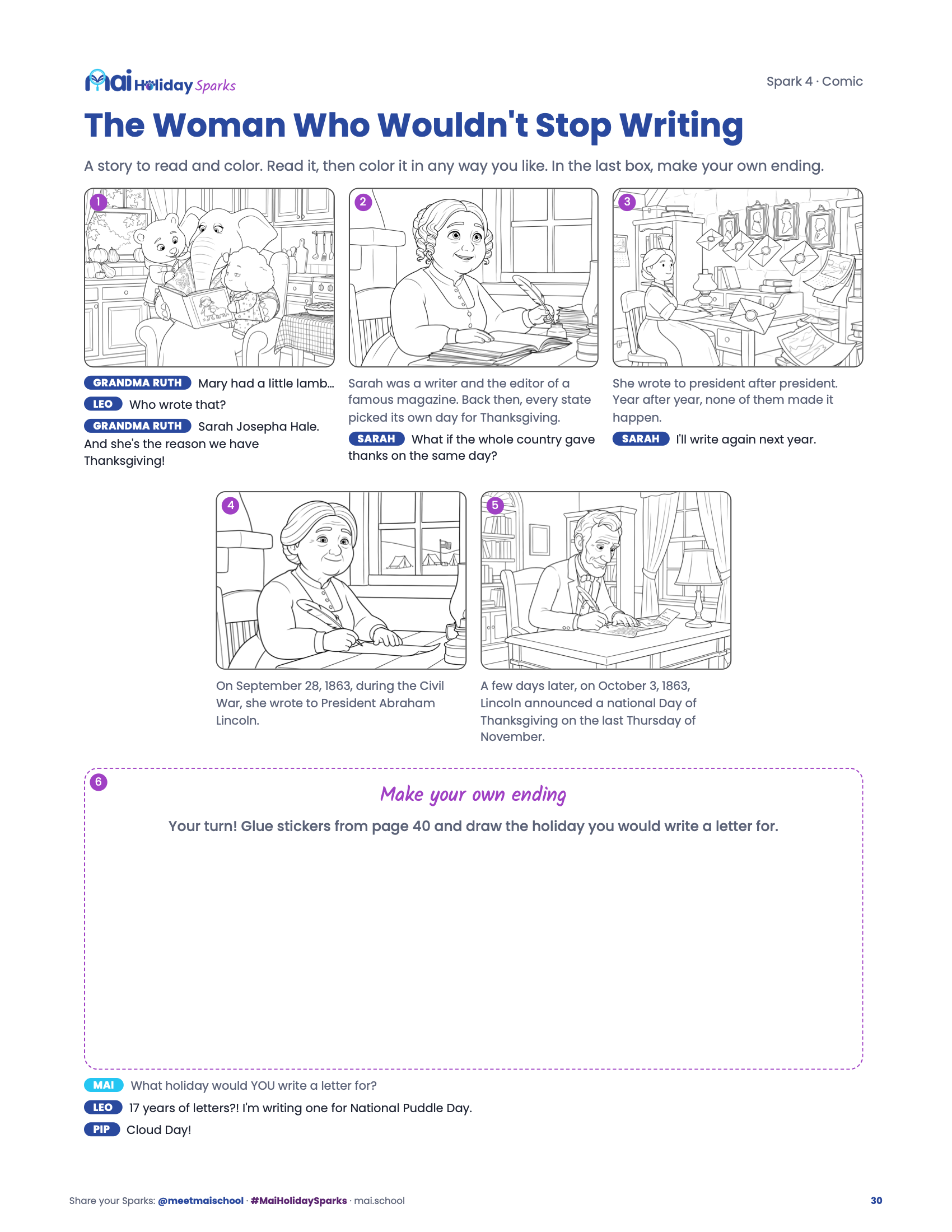
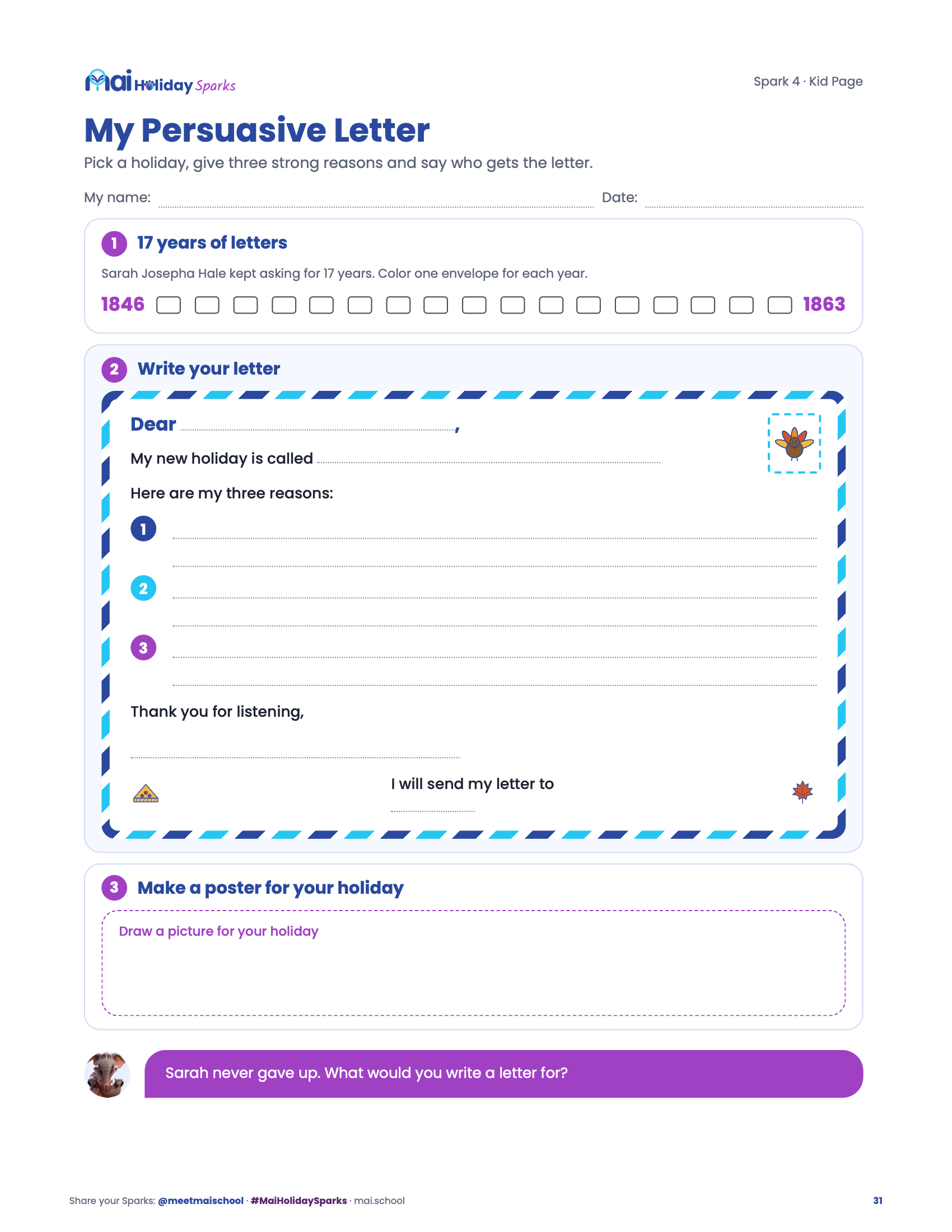
Discover Sarah Josepha Hale, the woman who campaigned for 17 years to make Thanksgiving a national holiday. The Spark opens with the comic "The Woman Who Wouldn't Stop Writing," then explores the power of persistence and persuasion. It ends with your child writing their own persuasive letter for a holiday they wish existed.
Our goal: Learners will discover the remarkable efforts of Sarah Josepha Hale and how her long-term campaigning led to a national Thanksgiving Day. They will grasp the effectiveness of persistence and persuasion, then apply these skills by crafting their own persuasive letters for a new holiday.
What You Need
Paper • Pen • Crayons • Printable Worksheet
After this Spark: comic, kid page, stickers.
Learning Guide
A simple guide to lead you through the kickoff, the core challenge, and everything in between.
Mai’s Tips
- Meet them where they are: If younger children struggle with writing, let them draw their holiday and dictate their reasons. The goal is the idea of persuasion, not perfect handwriting.
- Focus on the 'why': When discussing persuasion, emphasize that it's about giving good reasons, not just asking. Ask, 'Why would that reason convince someone?'
- The power of time: Hale's 17-year campaign is a big number. Help older kids grasp this by relating it to something they've wanted for a long time, or discussing how much patience that would take.
- Not just words: Remind older children that campaigning can involve more than just letters—it can be speeches, organizing events or raising public awareness, all forms of persuasion.
Prep Before Session 5 min
- Print the 'Persuasive Letter Template' worksheet from the Spark pack.
1Introduction 5 min
Read the comic together: "The Woman Who Wouldn't Stop Writing." Then ask the big question: "Who made Thanksgiving a national holiday, and how long did it take?" Let your child answer in their own words. Wild guesses are welcome.
Know Before You Teach
- Good to know: In 1863 President Lincoln proclaimed a national Thanksgiving Day, and it has been celebrated every year since.
- President George Washington declared a national day of thanksgiving in 1789. It was a one-time day, not a yearly holiday.
- Before 1863, states celebrated Thanksgiving on different days, or not at all.
- If they ask: Did the Pilgrims celebrate Thanksgiving? They had a harvest feast in 1621, which inspired the idea, but it wasn't the official holiday we know today.
- It's working when: The child making a guess, even if it's far-fetched, shows engagement with the question.
- If they're stuck: If they're hesitant, offer a few wild possibilities to spark their imagination: 'Do you think it was a king? Or maybe a baker?'
- Easier: Just accept any guess without pressing for details. Focus on the 'who' or the 'how long' as separate ideas.
- Harder: Ask them to justify their guess: 'What makes you think that person might have made it a holiday?'
Done when: The child has given an answer about who made Thanksgiving a national holiday and how long it took.

2Explore & Plan 8 min
Build the timeline on the worksheet together. Mark these points:
- 1846: Sarah Josepha Hale starts asking for a national Thanksgiving. She is the editor of Godey's Lady's Book, one of the most popular magazines in the country. Hale is credited with writing "Mary Had a Little Lamb."
- Year after year she writes articles and letters. She writes to five presidents: Taylor, Fillmore, Pierce, Buchanan and Lincoln.
- 1863: President Lincoln proclaims a national Thanksgiving Day. It has been celebrated every year since.
Count the years together: 17. Then ask: "What kind of person keeps trying for so long?"
Know Before You Teach
- Good to know: Sarah Josepha Hale (1788-1879) was a writer and the editor of Godey's Lady's Book, a popular magazine.
- She is credited with writing the nursery rhyme 'Mary Had a Little Lamb.'
- From 1846 she campaigned for a national Thanksgiving. She wrote to Presidents Taylor, Fillmore, Pierce and Buchanan, who did not act and then to Lincoln on 28 September 1863. Lincoln's proclamation came five days later.
- If they ask: Why did it take so long? It was a big idea to get all the states to agree, and presidents had many other things to focus on, especially during the Civil War.
- If they ask: What is an editorial? It's an article in a newspaper or magazine that shares the editor's opinion and tries to convince readers.
- It's working when: The child showing surprise or admiration for Hale's long effort.
- If they're stuck: If they're not grasping the timeline, draw a simple line and mark 'start' and 'finish' with '17 years' in between.
- Easier: Mark only the start (1846) and the end (1863) on the timeline, and count the years together.
- Harder: Discuss what might have motivated Hale to keep going for 17 years despite not seeing immediate results.
Done when: The child has marked the start and end of Hale's campaign on the timeline and counted the years.

3Discussion 6 min
Explain the concepts of 'persuasion' and 'campaigning,' using everyday examples. Then, guide a conversation about Hale's use of these strategies.
- Persuasion is when you try to convince someone to agree with your idea or do what you want, by giving them good reasons.
- A campaign is a series of actions you take over time to make a big goal happen.
- Can you think of a time you tried to persuade someone to do something or agree with you?
- What reasons did you use? Were they good reasons?
- How is what Sarah Josepha Hale did like your example, and how is it different?
The core idea is that Hale changed minds and made things happen by consistently presenting good reasons (persuasion) over a long time (campaign). For older kids, you might discuss the difference between logical and emotional appeals; for younger kids, focus on giving good reasons.
Know Before You Teach
- Good to know: Persuasion involves presenting logical reasons, emotional appeals or evidence to change someone's mind.
- Hale used her writing skills and position as an editor to spread her message widely.
- If they ask: Is nagging the same as persuading? Nagging often doesn't give new reasons, it just repeats. Persuading offers new ideas or evidence.
- If they ask: Can I persuade someone without talking? Yes, you can write a letter, create a sign or even show them something, like a picture or a graph with facts.
- It's working when: The child providing examples of persuasion from their own life that include specific reasons.
- If they're stuck: Suggest a common scenario: 'What if you really want a new toy? How would you try to convince me?'
- Easier: Focus on simple 'giving reasons' examples, like 'I want to go to the park because it's sunny and I finished my chores.'
- Harder: Ask them to identify different types of reasons: 'Did you use a feeling, a fact or what you believed was fair?'
Done when: Student can explain what persuasion means in their own words and give an example of how someone might try to persuade another person.
4Activity 9 min
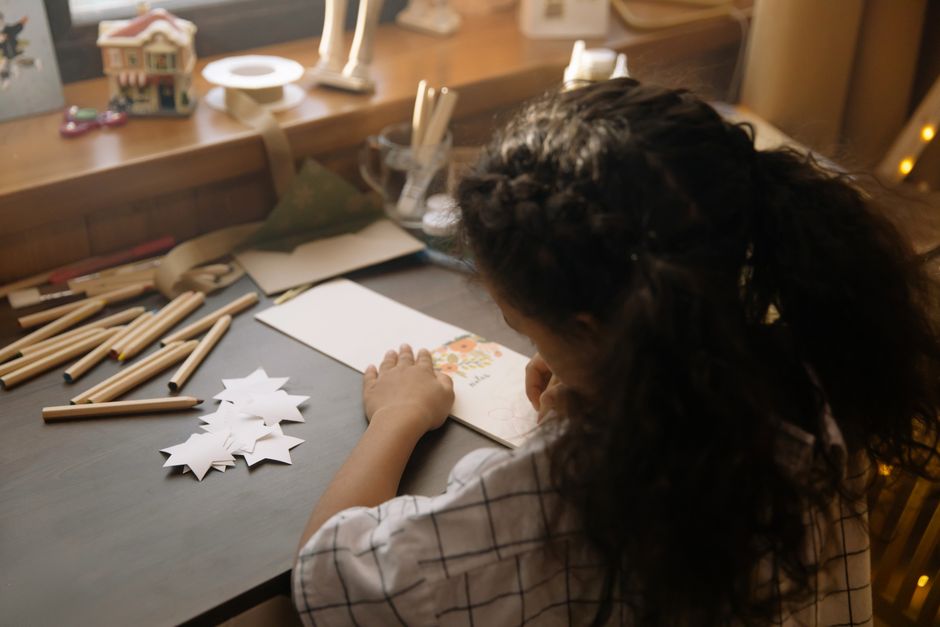
Challenge them to create their own holiday and write a persuasive letter using the provided worksheet. Guide them to brainstorm a holiday, think of three strong reasons and decide who they would send their letter to. Encourage creativity and strong arguments.
- What new holiday would you create?
- Who would you need to convince to make it a national holiday?
- What are three strong reasons why this holiday should exist?
Know Before You Teach
- Good to know: Using specific examples and details can make arguments stronger.
- Hale's campaign showed that consistent, well-reasoned communication can lead to significant change.
- If they ask: What if my reasons aren't very good? That's okay! This is practice. The more you think about it, the better your reasons will become. Let's try to make them even stronger.
- If they ask: Who should I send my letter to? Someone who has the power to make your holiday real, like a mayor, a governor or even the President. Or maybe just someone in your family!
- It's working when: The child showing creativity in their holiday idea and attempting to articulate reasons, even if simple.
- If they're stuck: Help them brainstorm: 'What's something you love to do that doesn't have a holiday? A 'Cloud Gazing Day' or 'Pajama Party Day'?'
- Harder: Challenge them to think about counter-arguments: 'What might someone say against your holiday, and how would you respond?' Encourage proper letter structure (greeting, closing).
Done when: Student has completed their persuasive letter, including the holiday name, three reasons and who they would send it to, either by writing or drawing on the worksheet.

5Summary 2 min
Celebrate their finished letters and reflect on the Spark. Ask questions to help them connect Hale's story to their own experience and the broader impact of persistence and persuasion.
- What was the most interesting or surprising thing you learned about Thanksgiving today?
- What qualities do you think Sarah Josepha Hale had that helped her succeed?
Know Before You Teach
- Good to know: Persistence (never giving up) is a key trait of successful campaigners.
- Even one person's voice can make a difference if they are consistent and persuasive.
- Many national holidays have interesting historical origins and sometimes involved long campaigns.
- If they ask: Are there other holidays that took a long campaign? The first bill for Martin Luther King Jr. Day was proposed four days after he died in 1968. The holiday became law in 1983.
- It's working when: The child expressing an understanding of the impact of one person's actions or the importance of perseverance.
- If they're stuck: Reiterate: 'Imagine if Sarah Josepha Hale gave up after just one year. What would have happened?'
- Easier: Ask them: 'What was your favorite part of learning about Sarah Josepha Hale today?'
- Harder: Ask: 'How might Sarah Josepha Hale's campaign have been different if she lived today with email and social media?'
Done when: Student shares one key takeaway from the Spark, such as the power of persistence, persuasion or Sarah Josepha Hale's role.
Beyond The Spark
Fuel their curiosity beyond the Spark with bonus extras.
Table Talk
The ability to persuade and campaign effectively is essential in many professions, from marketing and law to politics and community organizing.
Did You Know?
Hale wrote to President Lincoln on 28 September 1863. Just five days later, he announced the national Thanksgiving.
Challenge
Research another historical figure who used persuasion or campaigning to make a significant change. How long did it take them, and what methods did they use?
Quick Recap Quiz 4 min
Customize this quiz, add questions, or follow your child's lead! Each question has a 'Parent Tip' to help them find the answer without giving it away.
1. Who was the writer who campaigned to make Thanksgiving a national holiday?
- Martha Washington
- Sarah Josepha Hale
Look back at the comic. Who kept on writing?
2. Roughly how many years did she campaign for Thanksgiving?
- About 17 years
- About 5 years
Look at the timeline you made in Stage 2.
3. What does it mean to 'persuade' someone?
- To tell them what to do
- To convince them with reasons
Think back to the times your child tried to convince you of something.
4. Which President proclaimed a national Thanksgiving Day in 1863?
- President Lincoln
- President Jefferson
Look at the end of your timeline.

Spark 5 of 5
Keeping the Harvest
This Spark challenges families to discover how people kept food long before refrigerators. Through a simple experiment with cucumber and apple slices, learners explore the science behind drying and salting and see how they stop food from spoiling. You set up the experiment today, then come back on day 3 for a 5-minute check-in to see what changed.
Our goal: Learners will understand how traditional food preservation methods like drying and salting prevent spoilage by removing water. They will be able to observe, record and explain the effects of these methods on food over time.
What You Need
Cucumber • Apple • Salt • Small plates • Paper towels • Small zip-top bags • Knife • Pen or Pencil • Experiment Log (worksheet or paper)
After this Spark: kid page.
Learning Guide
A simple guide to lead you through the kickoff, the core challenge, and everything in between.
Mai’s Tips
- Safety first: A grown-up does the slicing, and nobody tastes the samples. Once a sample looks fuzzy or smells bad, do not touch or sniff it. Put it in a bag and throw it away with the grown-up.
- Patience is key: The biggest changes take about 3 days, which is why there is a Day 3 check-in. Observing over time is a core part of real science. Don't rush to conclusions on Day 1.
- Microorganisms misconception: Children often think food just 'gets old.' The key nuance to convey is that invisible living things are eating the food. If they struggle, use the analogy of tiny, tiny creatures at a buffet.
- Simplify the 'why': If the concept of water removal isn't landing, simplify to 'microorganisms get thirsty and can't grow without water.' For salt, say 'salt sucks the water right out of the food, making it too dry for those thirsty little guys.'
- Mold alert: The plain cucumber and the sealed apple may grow mold. This is part of the learning! Mold is a type of microorganism that spoils food.
1Introduction: The Winter Challenge 5 min
Begin by setting the scene for Thanksgiving long ago, when refrigerators didn't exist. Ask the central question of the Spark and let your child brainstorm freely. There are no wrong answers at this stage – just encourage creative thinking.
Know Before You Teach
- Good to know: Thanksgiving celebrates harvest and gratitude, often with historical connections to early American settlers and Native Americans.
- Before modern refrigeration, food preservation was essential for survival through winter.
- The Wampanoag dried their corn and beans to eat in winter, and kept some other foods by drying or smoking them.
- If they ask: Did they have refrigerators back then? No, refrigerators were invented much later. People had to find other ways to keep food from spoiling.
- It's working when: Child offering varied ideas, even if not fully correct (e.g., 'keep it cold,' 'put it in a cellar').
- If they're stuck: Suggest thinking about how nature might keep things fresh, like when leaves dry up.
- Easier: Focus on just one food item they know (like berries) and ask how their grandparents might have kept it for a long time.
- Harder: Ask them to think about different types of food (meat, fruit, vegetables) and if they'd need different methods.
Done when: Student has shared at least one idea about how food might have been kept from spoiling.

2Explore & Plan: Our Food Preservation Test 8 min
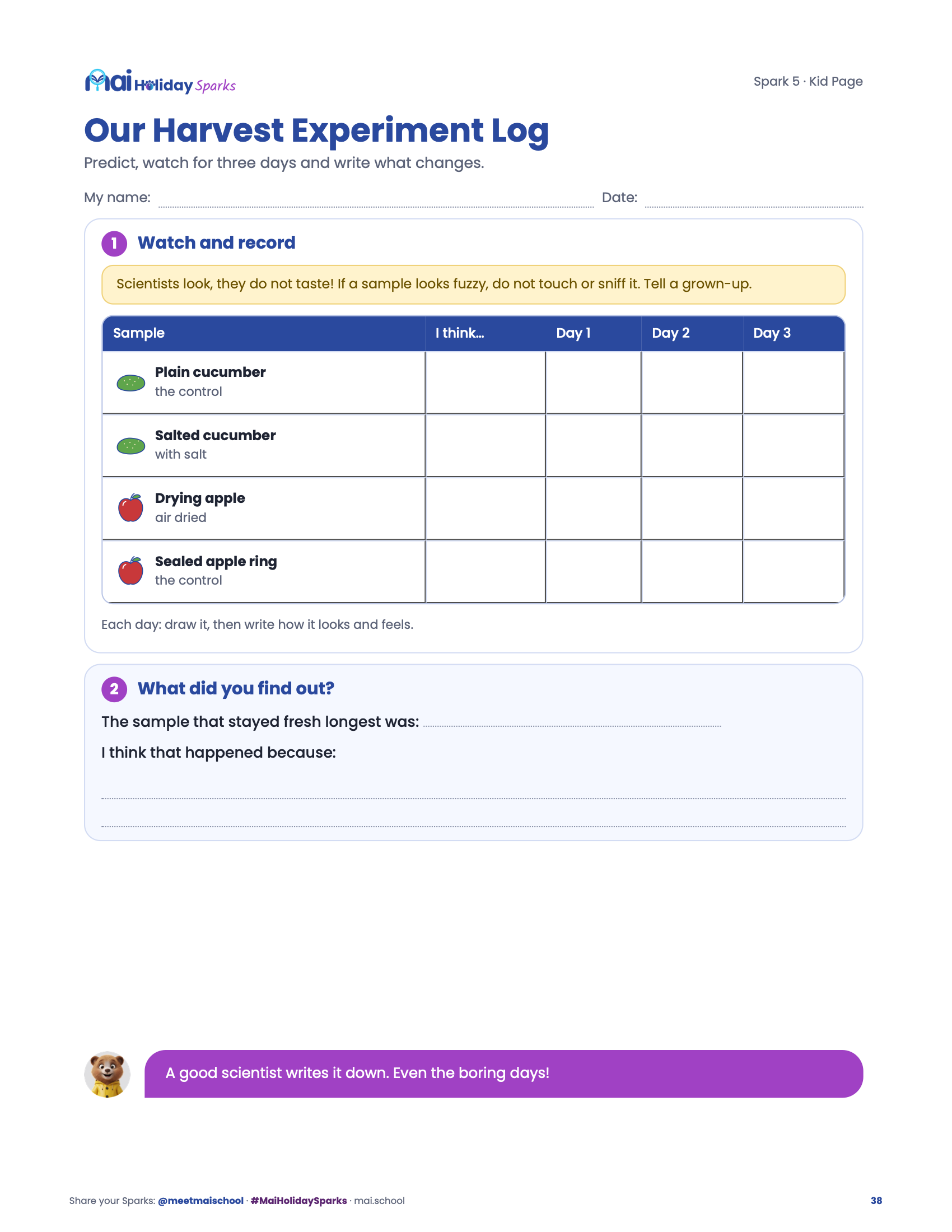
Explain that you will test two old ways to keep food: salting and drying. Each one gets a 'control,' a sample you leave alone so you can compare. The plain cucumber is the control for the salted cucumber. The apple ring sealed in a bag is the control for the drying apple. Ask your child to predict what will happen to all four, then show them the experiment log.
Know Before You Teach
- Good to know: Salting draws moisture out of food, making it less hospitable for spoilage organisms.
- Drying removes water, which is essential for microbial growth.
- A control group in an experiment is crucial for comparison to see if the tested variable (salt, drying) has an effect.
- Key words: Control: In an experiment, the control is the part that you don't change or treat, so you can compare it to the parts you do change.
- It's working when: Child making clear, distinct predictions for each sample (e.g., 'salted will get wrinkly,' 'plain will get yucky').
- If they're stuck: Ask them to describe what happens to food they leave out on the counter for a few days.
- Easier: Focus only on predicting what the salted cucumber will look like, using a simpler visual comparison (e.g., 'like a prune').
- Harder: Ask them to predict why each change will happen, linking it to water or other factors.
Done when: Student has made a prediction for each of the four samples.

3Discussion: The Science of Spoilage 6 min
This is where you explain the core concepts. Start by defining what causes food to spoil (microorganisms) and what they need to survive (water). Then connect this to how salting and drying remove or make water unavailable. Use simple language and ask guiding questions.
Know Before You Teach
- Good to know: These microorganisms require water to grow, reproduce and break down food.
- If they ask: Can I see microorganisms? No, they're too tiny to see with just your eyes! You'd need a special microscope to see them, but they are all around us and on our food.
- Key words: Microorganisms: Tiny living things, like bacteria and mold, that are too small to see without a microscope.
- Key words: Spoilage: When food goes bad, often because microorganisms are growing on it, making it unsafe or unpleasant to eat.
- Key words: Dehydration: The process of removing water from something, like drying fruit.
- It's working when: Child making the connection between water, microorganisms and spoilage, even if simple.
- If they're stuck: Use the analogy of a plant needing water to grow; if it doesn't get water, it shrivels and dies. Microorganisms are similar.
- Easier: Focus only on the idea that 'thirsty tiny bugs' can't grow without water, without naming 'microorganisms'.
- Harder: Ask them to think about other ways we keep food fresh in the fridge or freezer, and how that might work differently.
Done when: Student can explain in their own words that food spoils due to microorganisms and that drying/salting prevent this by removing water.

4Activity: Setting Up Our Experiment 9 min
Help your child set up the four samples. A grown-up does the slicing. Label each sample clearly. Then help them make their Day 1 notes in the experiment log, using what they can see and feel.
Know Before You Teach
- Good to know: Careful observation here means looking and feeling. Nobody tastes the samples.
- Consistent recording helps track changes accurately over time.
- If they ask: How much salt should I put on? Put enough salt on so that the entire top surface is covered, like a light dusting of snow. We want to really see the salt's effect.
- It's working when: Child carefully applying salt or arranging the apple, and making detailed initial observations beyond just 'good'.
- If they're stuck: If they're unsure what to write, ask: 'What color is it? Is it shiny or dull? Does it feel firm or soft?'
- Easier: The grown-up slices, salts and seals. Your child places the samples and draws what they see.
- Harder: Ask the child to consider where the best place in the house would be to dry the apple, and why (e.g., sunny window, low humidity).
Done when: All four samples are set up and labeled, and Day 1 notes are in the experiment log.

5Summary: The Harvest's Secrets Revealed 2 min
Explain that the samples need a few days to change, so the experiment keeps going after today. Talk about what they expect each sample to look like, and connect it to families keeping their harvest for winter.
Day 3 check-in (worksheet page, about 5 minutes): on day 3, look at the samples, fill in day 3 of the log and compare with your predictions. Ask: 'What surprised you? Which method worked best, and why?' Once a sample looks fuzzy or smells bad, do not touch or sniff it. Put it in a bag and throw it away with the grown-up.
Know Before You Teach
- Good to know: The plain cucumber will likely show signs of spoilage (softening, discoloration, possibly mold) first.
- The salted cucumber will become limp and release water.
- The drying apple will shrink and turn leathery as it loses water.
- The sealed apple ring can't lose its water, so it stays soft and may start to spoil.
- If they ask: Why did the plain cucumber go bad so fast? Because it had all the water those tiny microorganisms needed to grow and start breaking it down! The salt and drying methods took that water away.
- It's working when: Child making connections between their observations and the explanations from Stage 3 (e.g., 'The salted one dried out, so the germs couldn't eat it').
- If they're stuck: Help them compare two specific items: 'Look at the salted cucumber and the plain cucumber. What's the biggest difference you see?'
- Easier: Focus on just one pair of samples (e.g., salted vs. plain cucumber) and what happened to them.
- Harder: Ask them to imagine another food item and predict which preservation method (salting or drying) might work best for it, and why.
Done when: Student can describe what they expect to see over the next few days and connect the experiment back to the main question of preserving food for winter.
Beyond The Spark
Fuel their curiosity beyond the Spark with bonus extras.
Table Talk
Food preservation is crucial for reducing food waste and ensuring food security worldwide, from home canning to industrial freezing.
Did You Know?
Honey almost never spoils because it has very little water and is a little acidic.
Challenge
With a grown-up, try drying other fruit, like grapes or banana slices. Research traditional methods from different cultures, such as pickling or fermentation and discuss how they might work.
Quick Recap Quiz 4 min
Customize this quiz, add questions, or follow your child's lead! Each question has a 'Parent Tip' to help them find the answer without giving it away.
1. What do tiny, invisible living things called microorganisms need most to grow on food and spoil it?
- Darkness
- Water
Look back at Stage 3: what do tiny living things need to grow?
2. How does salting help keep food from spoiling?
- It pulls water out of the food.
- It keeps the food cold.
Look at your salted cucumber. What came out of it?
3. Why did people dry fruits like apples to keep them for winter?
- Drying kills every germ in the fruit.
- Drying removes water, stopping spoilage.
Look at your drying apple. What did it lose?
4. If you wanted to keep fresh berries from spoiling for a long time without a fridge, what old method would be best?
- Drying them in the sun or an oven.
- Putting them in a dark cupboard.
Which of your samples changed the least, and what did you do to it?
Loved These Sparks?
There is a lot more curiosity where these came from.
See more Sparks
Find free Sparks and Mai's Daily Spark at mai.school
Create your own
Type your child's question in the Mai app, and Mai turns it into a Spark made just for them.
Find similar
Search "Thanksgiving" or any topic your child loves in the Sparks Hub to find more like these.
Feel free to share this pack with friends you think would enjoy it. Share your Sparks with us on Instagram @meetmaischool, Facebook (Mai School) or YouTube (Mai School) #MaiHolidaySparks