
What Is Kwanzaa?
Explore Kwanzaa, a celebration of African American heritage and community. Children learn about its origins, meaning and values, then bring three of its principles into their own family life on a Kinara worksheet.
Our goal: Learners will understand the history and purpose behind Kwanzaa, including the meaning of its seven core principles. They will be able to explain these principles and apply them to their own family life by creating a personalized Kinara.
What You Need
Kinara worksheet • Crayons or markers • Pencil
and this is just the baseline.
Scan to jump into the app and easily personalize this Spark to match your child's exact learning level and see how Mai will guide this lesson.
Learning Guide
A simple guide to lead you through the kickoff, the core challenge, and everything in between.
Mai’s Tips
- Safety first: This Spark uses crayons only. If your family lights a real Kinara, a grown-up lights the candles, keeps them away from paper and never leaves them burning. If you share foods at a Karamu feast, check for allergies first.
- Mind trap: Many people think Kwanzaa is a religious holiday or a version of Christmas. Emphasize that it is a cultural celebration focused on community values. If your child brings up gifts or religion, gently redirect to the principles of unity, purpose and creativity.
- Keep it secular: Kwanzaa is designed to be a secular, cultural celebration. Avoid any language that suggests it is a religious observance. Stick to the historical and cultural context.
- Keep it small: This Spark covers three principles. For a younger child, even two is plenty: Unity (Umoja) and Creativity (Kuumba). The others wait on the worksheet strip for their own days.
- Values are personal: The goal isn't to get 'correct' answers for the family actions, but to encourage genuine reflection. There are no right or wrong ways to live out these values, only what feels authentic to your family.
Prep Before Session 5 min
- Print the Kwanzaa Kinara worksheet provided in the Spark pack.
1Introduction 5 min
Open the Spark by asking the hook question to gauge the child's existing knowledge and spark their interest. This helps them connect to what they already know (or don't know!) about Kwanzaa.
- What is Kwanzaa, and why do you think it lasts seven days?
Know Before You Teach
- If they ask: Is Kwanzaa like Christmas? They are different holidays. Kwanzaa celebrates African American heritage and community values. Some families celebrate both.
- It's working when: The child shows curiosity by asking questions or sharing previous knowledge about celebrations.
- If they're stuck: If the child has no ideas, offer a hint: 'Many celebrations have special meanings or purposes. What kind of purpose might a seven-day celebration have?'
- Easier: Just ask 'Have you ever heard of Kwanzaa?' and listen to their response, keeping it very open-ended.
- Harder: Ask: 'If you were to create a new celebration for our family, what would it be about and how long would it last?'
Done when: Child shares initial thoughts or questions about Kwanzaa.

2Explore & Plan 8 min
Have the Kinara worksheet and crayons ready. Show your child the Kinara, the Kwanzaa candle holder. It holds seven candles: one black candle in the middle, three red candles on the left and three green candles on the right. Before you share the principles, let your child guess what a seven-day celebration might be about.
- We're going to make our own Kinara. What ideas do you think a seven-day celebration might focus on?
Know Before You Teach
- Good to know: The Kinara holds seven candles: one black candle in the middle, three red candles on the left and three green candles on the right.
- One candle is lit each night of Kwanzaa, starting with the black candle.
- If they ask: What are the seven ideas? We'll learn about those very soon! For now, let's just think about what kinds of good ideas a family might want to celebrate together.
- It's working when: Child shows interest in the materials and makes a general prediction about celebrating 'good' or 'family' ideas.
- If they're stuck: If they struggle to predict, give a concrete example: 'Maybe it's about being kind to each other, or working together?'
- Easier: Just focus on preparing the coloring tools and asking 'Which colors do you think would be good for our Kinara?'
- Harder: Ask: 'If each day has a different idea, why do you think it's important to have a specific idea for each day, instead of just one big idea for the whole week?'
Done when: Child has the materials ready and has made predictions about Kwanzaa's focus or values.

3Discussion 6 min
Read the comic together. Then introduce the Nguzo Saba, the Seven Principles of Kwanzaa. Families celebrate one each day, from December 26 to January 1:
- Umoja: unity
- Kujichagulia: self-determination
- Ujima: collective work and responsibility
- Ujamaa: cooperative economics
- Nia: purpose
- Kuumba: creativity
- Imani: faith. Faith here means believing in your family, your community and your future.
On December 31, many families share a big feast called the Karamu.
- Why do you think celebrating 'first fruits' might be a good way to remember a culture and its history?
- How is celebrating values different from celebrating with gifts?
Know Before You Teach
- Good to know: Kwanzaa was created in 1966 by Dr. Maulana Karenga, to celebrate African American heritage and African roots.
- The name comes from the Swahili phrase 'matunda ya kwanza', which means 'first fruits'.
- Kwanzaa is a cultural holiday, not a religious one.
- Kwanzaa runs from December 26 to January 1, one principle per day. Many families share a feast, the Karamu, on December 31.
- If they ask: Why was it created in 1966? It was created during a time when many African Americans were looking for ways to celebrate their history and culture with pride and strength.
- Key words: Kwanzaa: A celebration of African American heritage and African roots, held from December 26 to January 1.
- Key words: Swahili: An African language spoken in many countries, where the name Kwanzaa comes from.
- Key words: Karamu: The Kwanzaa feast, held on December 31.
- If they're stuck: Ask, 'What do people celebrate at harvest time?' Then link it to a community celebrating the good things it has grown together.
- Easier: Focus on 'Kwanzaa means celebrating family history and good ideas' and 'Nguzo Saba means Seven Principles'.
- Harder: Ask: 'How might celebrating 'first fruits' connect to remembering ancestors and building for the future?'
Done when: Child can say in their own words what Kwanzaa celebrates and that Nguzo Saba means Seven Principles.
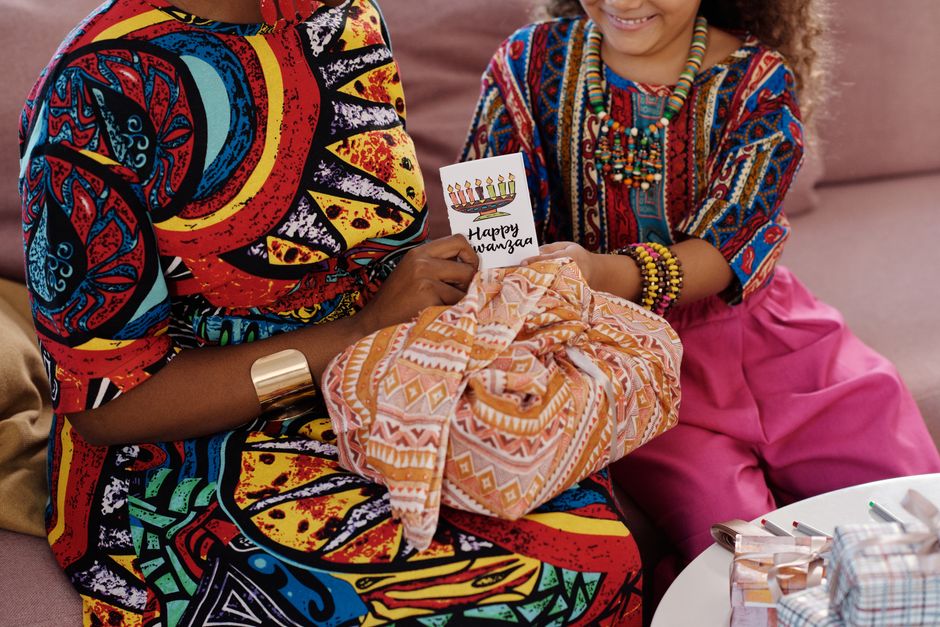
4Activity 9 min
Color the Kinara on the worksheet together. In this Spark you explore three principles: Umoja, Nia and Kuumba. For each one, color a candle, talk about what it means and write one way your family can live it.
- What does Umoja (unity) mean to you? How can our family show unity?
- What does Nia (purpose) mean? What important goal do we have as a family?
- What does Kuumba (creativity) mean? How can we make our home or community more beautiful?
The worksheet strip has a box for every day of the holiday. Copy today's three ideas into their days. Save the other four principles, Kujichagulia, Ujima, Ujamaa and Imani, for their own days: talk about one each day and write your family's action in its box.
Know Before You Teach
- Good to know: Each principle guides actions for family and community well-being.
- If they ask: What's the difference between Ujima and Ujamaa? Ujima is about working together for the community, like volunteering. Ujamaa is about supporting businesses and sharing resources within the community to help everyone thrive, like buying from a local shop or sharing tools.
- Key words: Umoja: Unity: being together as one family and community.
- Key words: Nia: Purpose: working toward goals that help your family and community.
- Key words: Kuumba: Creativity: making your home and community more beautiful than you found it.
- It's working when: Child colors, asks questions about the principles and tries to connect each one to a family action.
- If they're stuck: If a child struggles to think of a family action for a principle, offer a very simple example: for Umoja (unity), 'What if we all help set the table together?'
- Easier: For younger children, color the three candles and talk about the family actions out loud. A grown-up can write them down.
- Harder: For older children, ask how each of the three principles could make their school or neighborhood better, or draw their family action next to each candle.
Done when: Child has colored three candles and named one family action each for Umoja, Nia and Kuumba (said out loud or written).

5Summary 2 min
Praise your child's ideas for living out the Kwanzaa principles. Ask reflection questions about how values make families and communities stronger. Put the strip where your family will see it from December 26.
- How do you think celebrating these kinds of values for seven days might help a family or a community become stronger?
- Which of the Nguzo Saba do you think is most important for our family right now?
Know Before You Teach
- Good to know: The principles of Kwanzaa can be applied throughout the year, not just during the holiday.
- It's working when: Child can articulate at least one principle and how it contributes to family or community strength.
- If they're stuck: If the child struggles, prompt them with: 'Think about a time when our family worked together (Ujima). How did that feel and what did it accomplish?'
- Easier: Simply ask: 'Which principle did you like the most?' or 'What was the coolest thing you learned about Kwanzaa?'
- Harder: Ask: 'How might living by these principles change how people treat each other in your school?'
Done when: Child shares one key takeaway or favorite principle from Kwanzaa and how it could make a family stronger.
Beyond The Spark
Fuel their curiosity beyond the Spark with bonus extras.
Table Talk
Companies and organizations often have 'core values' similar to the Nguzo Saba, using them to guide how they work and interact.
Did You Know?
The Kinara's seven candles come in three colors: one black candle in the middle, three red on the left and three green on the right.
Challenge
Research a famous person or historical event that strongly embodies one of the Nguzo Saba (Seven Principles) and share why you think so.
Quick Recap Quiz 4 min
Customize this quiz, add questions, or follow your child's lead! Each question has a 'Parent Tip' to help them find the answer without giving it away.
1. What is Kwanzaa mainly a celebration of?
- Religious beliefs and traditions
- African American heritage and community values
Think back to the comic: who was Kwanzaa created for, and what do families celebrate each day?
2. How many days does Kwanzaa last?
- Seven days
- Twelve days
Look at the strip on your worksheet. How many boxes does it have?
3. What does Nguzo Saba refer to in Kwanzaa?
- Traditional Kwanzaa foods
- The Seven Principles or values
Think about what families talk about on each day of Kwanzaa.
4. Which principle means 'unity'?
- Umoja
- Kuumba
Umoja sounds a bit like 'one' or 'united', which is what unity means.
Loved This Spark?
Scan to jump into the app and explore similar Sparks in our Sparks Hub. New to Mai? Start free with 10 Sparks, no credit card needed.