
What Is Hanukkah?
This Spark introduces families to Hanukkah and its ancient story of courage and a miracle of light. Discover traditions like lighting the menorah, spinning the dreidel and enjoying special foods, all connected to a message of hope and dedication.
Our goal: Learners will understand the incredible tale of courage and miracles that inspired Hanukkah. They will also discover the special traditions like the menorah and dreidel, and learn how these ancient events continue to bring joy and hope to families today.
What You Need
Paper • Crayons or markers • Small coins or candies • Toy dreidel • Printable worksheet
and this is just the baseline.
Scan to jump into the app and easily personalize this Spark to match your child's exact learning level and see how Mai will guide this lesson.
Learning Guide
A simple guide to lead you through the kickoff, the core challenge, and everything in between.
Mai’s Tips
- Safety first: Coins, candies and buttons are choking hazards for small children. Supervise the dreidel game and keep game pieces away from children under 3. If your family lights a real menorah, a grown-up does the lighting and candles never burn unattended.
- Meaning of Light: The core concept of Hanukkah is the miracle of light, both literally (the oil) and symbolically (religious freedom, hope). Guide discussions back to this theme to deepen understanding.
- Avoiding Confusion: Children might link Hanukkah only with gifts because it comes near other gift-giving holidays. Gently steer conversations back to the story of the oil, freedom and dedication as the main reasons for celebrating.
- Simplify Story: For younger children, focus on 'a small amount of oil lasting a long time' and 'celebrating with lights.' For older children, you can add a little about the history of fighting for religious freedom.
- Cultural Respect: Hanukkah is a joyful celebration for Jewish families. Some families celebrate Hanukkah and some are learning about it. Both are welcome here.
For The Grown-Up
- A common mix-up: Hanukkah is just about gifts, like other winter holidays, or it's simply 'Jewish Christmas'.
- Try this: After reading the comic, ask: 'Does Hanukkah sound like it's mainly about gifts, or about something else like courage and a miracle? What makes it special for Jewish families?'
- Explain it like this: The oil lasting eight nights is like a tiny flashlight battery that just keeps going and going, much longer than anyone thought possible, giving light when it was most needed!
- A big question to ask: If the oil had lasted only one night instead of eight, do you think Hanukkah would still be celebrated as a festival of lights today? Why or why not?
1Introduction 5 min
Begin by setting a warm, curious tone. Ask your child the main hook question to get them thinking and sharing any prior knowledge. Don't worry about corrections at this stage; just listen and encourage their thoughts.
Know Before You Teach
- Good to know: It commemorates a historical event that happened over 2,000 years ago.
- If they ask: Is Hanukkah like Christmas? Both are winter holidays, but they celebrate different stories and traditions. Hanukkah celebrates a miracle of light and freedom.
- It's working when: Child expressing curiosity or making a guess about the 'eight nights of light'.
- If they're stuck: Share a simple fact, like 'It's a holiday about light and a special story from long ago,' to prompt further interest.
- Easier: Focus on the 'eight nights of light' aspect and ask what they think light means.
- Harder: Ask if they know of any other holidays that celebrate freedom or miracles.
Done when: Student has shared initial thoughts or guesses about the hook question.

2Explore & Plan 6 min
Lay out the worksheet and crayons. No printer? Draw a simple menorah with nine candles. Look at the menorah together and let your child guess what it is for. Count its candles while your child colors. Save the picture match for later: it comes after the comic.
Know Before You Teach
- Good to know: The menorah is a central symbol of Hanukkah.
- It holds nine candles: one for each of the eight nights, plus a helper candle (shamash).
- If they're stuck: Point to different parts of the menorah and ask, 'What do you think this part is for?'
- Easier: Focus on counting the candle holders on the menorah.
- Harder: Ask them to predict why there might be a 'helper' candle, based on the number of nights.
Done when: Student has counted the candles on the menorah and started coloring it.
3Discussion 8 min
Read the comic together. Then go over the key words: Menorah (a special candle holder with nine branches), Shamash (the helper candle that lights the others), Dreidel (a spinning top) and Latkes (fried potato pancakes). Share one more fact: Hanukkah means "dedication" in Hebrew.
- How does lighting candles for eight nights connect to the comic?
- Why do you think eating fried foods, like potato pancakes, is part of Hanukkah?
Finish with the picture match on the worksheet: draw a line from each tradition to the part of the story it remembers.
Know Before You Teach
- Good to know: Hanukkah means "dedication" in Hebrew.
- Hanukkah celebrates the rededication of the Holy Temple in Jerusalem, more than 2,000 years ago.
- The story says a tiny jar of oil, enough for one day, kept the Temple lamp burning for eight days.
- If they ask: What are Maccabees? They were a small group of people who bravely fought for their religious freedom long ago.
- Key words: Menorah: A special Hanukkah candle holder with nine branches.
- Key words: Shamash: The helper candle that lights the other eight.
- Key words: Dreidel: A spinning top game played during Hanukkah.
- Key words: Latkes: Fried potato pancakes, a traditional Hanukkah food.
- It's working when: Child making connections between the story elements and the traditions (e.g., 'The oil is why they eat fried food!').
- If they're stuck: Turn back to the comic and ask, 'Which tradition reminds you of this part?'
- Easier: Focus on one link: the oil lasted eight days, so families light candles for eight nights.
Done when: Student has read the comic, connected at least one tradition to the story in their own words and tried the picture match.
4Activity 9 min
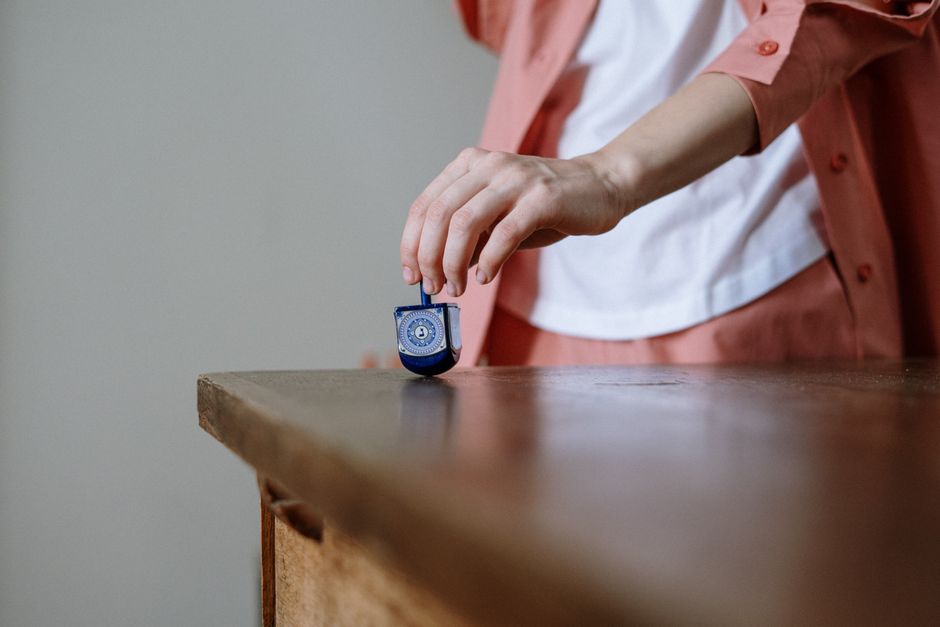
Play the dreidel game. A dreidel is a spinning top with a Hebrew letter on each of its four sides. Together the letters stand for "A great miracle happened there."
No dreidel? Make one in 30 seconds: fold a paper square in half both ways to find the middle, write one letter near each edge and push a pencil through the middle. Spin it like a top.
Give each player the same number of coins or candies. Everyone puts one in the middle to make the pot. Take turns spinning. The letter that lands facing up tells you what to do:
- Nun: nothing.
- Gimel: take all.
- Hey: take half.
- Shin: put one in.
When the pot is empty, everyone puts one in again. Play a few rounds. Enjoy the fun and talk about what the letters help families remember.
Know Before You Teach
- Good to know: The dreidel's four letters are Nun, Gimel, Hey and Shin. They stand for 'A great miracle happened there.'
- The rules: Nun, nothing. Gimel, take all. Hey, take half. Shin, put one in.
- If they ask: What do the letters mean? They stand for 'A great miracle happened there,' reminding everyone of the Hanukkah miracle.
- If they ask: Are all dreidels the same? In Israel, dreidels have the letter Pe instead of Shin, so they say 'A great miracle happened here.'
- It's working when: Child enjoys the game and understands it is a way to remember the miracle.
- If they're stuck: Start with just two letters: Gimel (take all) and Nun (nothing). Add Hey and Shin once the game feels easy.
- Easier: Focus on spinning and on winning or losing coins.
- Harder: Ask them to explain how playing a game helps people remember a story from long ago.
Done when: Student has played a round or two of the dreidel game (real or paper), with help reading the letters.

5Summary 2 min
Help your child look back on the Spark. Connect the celebration to light, freedom and hope. End with what surprised them or what they found most interesting.
Know Before You Teach
- If they ask: Is Hanukkah always at the same time every year? No. Hanukkah follows the Hebrew calendar, so its dates move around on our calendar, but it always begins in late November or December. In 2026 Hanukkah runs from the evening of December 4 to December 12.
- It's working when: Child articulating one specific thing they learned or found interesting.
- If they're stuck: Offer a choice: 'Did you like learning about the story or playing the dreidel game more?'
- Easier: Ask them to name one thing they saw or did related to Hanukkah today.
- Harder: Ask: 'How is celebrating a historical event different from celebrating a birthday?'
Done when: Student shares one key takeaway or connection from the Spark.
Beyond The Spark
Fuel their curiosity beyond the Spark with bonus extras.
Table Talk
Learning about different cultural celebrations helps us understand and appreciate the diverse ways people find meaning and joy in their lives.
Did You Know?
The menorah in the ancient temple had seven branches, but the Hanukkah menorah has nine!
Challenge
Design your own Hanukkah greeting card. What symbols and messages would you include to tell the story of light and freedom?
Quick Recap Quiz 4 min
Customize this quiz, add questions, or follow your child's lead! Each question has a 'Parent Tip' to help them find the answer without giving it away.
1. In the Hanukkah story, what lasted for eight days?
- A tiny bit of oil for the Temple lamp.
- A bag of gold coins.
Think back to the comic: what did the Maccabees find only a little of in the Temple?
2. What is the name of the special candle holder used during Hanukkah?
- A Menorah
- A Lantern
Look back at the candle holder your child colored on the worksheet.
3. Why do families often eat fried foods like latkes during Hanukkah?
- Because they are easy to make.
- To remember the miracle of the oil.
Ask: what do you need to fry food? Where did that show up in the comic?
4. What does the 'shamash' candle do on the menorah?
- It is the helper candle that lights the others.
- It stays unlit all eight nights.
Look at the candle that stands apart from the others on the menorah you colored.
Loved This Spark?
Scan to jump into the app and explore similar Sparks in our Sparks Hub. New to Mai? Start free with 10 Sparks, no credit card needed.