
Wacky Sentence Fun!
This challenge helps young learners understand how words connect to form sentences. Children will create their own 'word cards' and arrange them to build fun, wacky sentences. It's all about making words work together!
Our goal: In this spark, your learner will recognize that words are individual units of meaning, arrange words in a logical order to create simple sentences and communicate ideas using spoken sentences.
What You Need
Paper • Markers • Scissors
and this is just the baseline.
Scan to jump into the app and easily personalize this Spark to match your child's exact learning level and see how Mai will guide this lesson.
Learning Guide
A simple guide to lead you through the kickoff, the core challenge, and everything in between.
Mai’s Tips
- Encourage your child to draw pictures on their word cards even if they can't write all the words yet. The visual cue helps them connect the spoken word to the concept.
- Emphasize that there are no 'wrong' silly sentences during the activity. The goal is exploration and understanding how words fit together, even if the result is fantastical.
Prep Before Session 5 min
- Gather paper, markers, and child-safe scissors.
- Think of a few simple nouns (e.g., 'cat', 'ball'), verbs (e.g., 'run', 'eat'), and adjectives (e.g., 'big', 'silly') as examples to help brainstorm.
1Introduction 5 min
Begin by chatting about how we talk and share ideas. Ask them to think about how they tell you things.
Guiding questions:* "Have you ever thought about how we put words together to tell someone something?", "When we want to share a whole idea, like 'I want a snack,' do we use just one word or many words?", "What kinds of things do we say with many words?"
Encourage them to give examples of simple sentences they use every day, like "The dog barks" or "I am hungry."
Done when:* The child identifies that we use multiple words to communicate ideas.
Know Before You Teach
- Good to know: Sentences are how we share a complete thought or idea with others.
- Even short sentences like 'I am hungry' use more than one word to make sense.
- We use sentences all the time when we talk, often without even realizing it.
- If they ask: What's a sentence? It's like a group of words that tells a whole story or idea, not just one small piece.
- It's working when: The child gives an example of something they said using more than one word.
- If they're stuck: Say a short phrase like 'cookie' and ask if that tells a whole story, then say 'I want a cookie' and ask what the difference is.
- Easier: Ask them to point to things in the room and say the name, then ask them to say one thing they want about that item (e.g., 'I want the ball').
- Harder: Ask them to explain why saying just one word sometimes isn't enough to get their idea across.
Done when: Student identifies that we use multiple words to communicate ideas.
2Explore & Plan 8 min
Introduce the idea of creating a "Wacky Word Train" where each train car is a word, and linking them makes a sentence. Brainstorm different types of words we'll need for our train.
Vocabulary:*
Noun: A word for a "thing" – a person, place, animal, or idea. Like 'cat' or 'ball'. Nouns tell us who or what*.
Verb: A word for an "action" – something someone or something does. Like 'run' or 'jump'. Verbs tell us what's happening*.
Adjective: A word that "describes" a noun. Like 'big' or 'silly'. Adjectives tell us what kind*.
Guiding questions:* "What kinds of words do you think we need for our train cars?", "Do we need words for things?", "Do we need words for actions?"
After brainstorming, gather your materials: paper, markers, and scissors.
Done when:* The child has a basic understanding of different types of words and materials are ready.
Know Before You Teach
- Good to know: Words have different jobs in a sentence, like different train cars on a train.
- Small words like 'a', 'an', and 'the' are called articles and often go before 'thing' words (nouns) to make sentences sound right.
- The goal is not perfect grammar, but understanding that different types of words exist for different purposes.
- If they ask: Why do we need different kinds of words? Because words do different jobs! Some words are for things, some for actions, and some for describing things.
- It's working when: The child can give an example of a 'thing' word and an 'action' word when prompted.
- Harder: Ask them to brainstorm words for each category that start with a specific letter, like 'What are some 'thing' words that start with 'B'?'
Done when: Student has a basic understanding of different types of words (things, actions, describing) and is ready to make word cards.

3Discussion 6 min
Discuss why word order is crucial for sentences to make sense. Give examples of mixed-up words.
Guiding questions:* "Why do you think it's important that our words go in the right order?", "What would happen if I said 'jumps cat the' instead of 'The cat jumps'? Would that still make sense?", "How do we know what a sentence is trying to tell us?"
Vocabulary:*
Sentence:* A group of words put together in a special order to tell a complete idea or thought. It's like a complete train that can travel and share a message.
Done when:* The child can explain in their own words that word order matters for a sentence to make sense.
Know Before You Teach
- Good to know: In English, we usually put the 'who' or 'what' (the noun) before the 'what they do' (the verb) for sentences to make sense.
- Putting words in the right order helps everyone understand exactly what we mean when we speak or write.
- A sentence needs a subject (who or what it's about) and a verb (what that subject does or is) to be complete.
- It's working when: The child giggles or corrects the mixed-up word order example (e.g., 'jumps cat the').
- If they're stuck: Say 'Eat I apple' and then 'I eat apple' and ask which one sounds more like how we usually talk.
- Easier: Only use two-word sentences for examples of mixed-up order, such as 'Ball kick' versus 'Kick ball'.
- Harder: Ask them to fix a slightly longer mixed-up sentence, like 'ran fast the dog'.
Done when: Student can explain in their own words that word order matters for a sentence to make sense.

4Activity 9 min
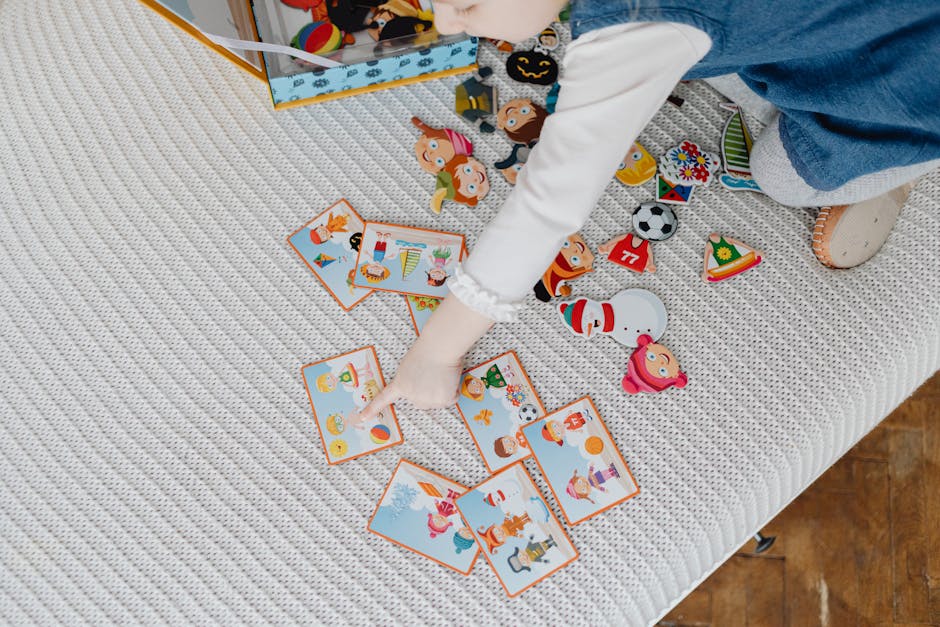
Help the child create their word cards. Encourage them to draw a simple picture for each word and write the word clearly on separate pieces of paper. Help them cut the paper into small cards.
Then, spread out the cards and guide the child to arrange them. Facilitate by suggesting combinations, but let the child lead.
Guiding questions:* "Can you link three cards to make a sentence?", "What new sentences can you build?"
Don't worry about perfect spelling or grammar; focus on words making a complete thought, even silly ones.
Done when:* The child has created at least 3-5 word cards and successfully arranged them into one or more simple sentences.
Know Before You Teach
- Good to know: Even very simple sentences like 'Big cat' or 'Cat jump' show words working together to create an idea.
- It's working when: The child tries to put at least two word cards together without being prompted by the parent.
- If they're stuck: Start a sentence with one of their cards (e.g., 'The cat...') and ask what the cat could do or what it's like.
- Easier: The parent creates a few basic word cards in advance (e.g., 'The', 'a', 'is', 'big', 'little', 'run', 'jump', 'cat', 'dog') for the child to use immediately.
- Harder: Introduce a punctuation card (a period '.') and ask the child where it should go at the end of a sentence.
Done when: Student has created at least 3-5 word cards and successfully arranged them into one or more simple sentences.

5Summary 2 min
Celebrate their hard work and creativity in building their Wacky Word Trains! Remind them they turned simple words into cool sentences.
Guiding questions:* "How did it feel to make your own sentences today?", "What was your favorite silly sentence that you built?", "Why do you think it's important for us to know how to put words together in sentences, both when we talk and when we write?"
Emphasize that sentences help us share our thoughts and feelings with others very clearly.
Done when:* The child shares one key takeaway about putting words together or why sentences are important for clear communication.
Know Before You Teach
- It's working when: The child can repeat one idea they learned about sentences (e.g., 'they tell ideas', 'words go in order').
- If they're stuck: Show one of their wacky sentences and ask, 'What idea did this sentence tell us?'
- Easier: Ask them to just name their favorite word card they made today.
- Harder: Ask them to think of a time they used a sentence to tell you something important today.
Done when: Student shares one key takeaway about putting words together or why sentences are important.
Beyond The Spark
Fuel their curiosity beyond the Spark with bonus extras.
Table Talk
People use sentences every single day to talk, read books, write messages, and share all their thoughts and ideas.
Challenge
Try to make the longest silly sentence you can with your word cards! Or, pick one word card and tell a short story using that word many times.
Quick Recap Quiz 4 min
Customize this quiz, add questions, or follow your child's lead! Each question has a 'Parent Tip' to help them find the answer without giving it away.
1. What is one 'word car' on our Wacky Word Train?
- A whole story
- A single idea or thing
Remind them that each card had just one picture and one word.
2. When we put word cars together to make a train, what are we making?
- A sentence
- A letter
Ask: 'Does a letter have many words that tell a whole idea?'
3. Why is it important for our word cars to be in the right order?
- So they look pretty
- So the sentence makes sense
Try saying a silly, mixed-up sentence again and ask if it makes sense.
4. Why do we use sentences when we talk to others?
- To share our ideas clearly
- To make funny noises
Ask: 'If you just said 'ball!' would I know what you meant? What if you said 'I want the ball'?'
Loved This Spark?
Scan to jump into the app and explore similar Sparks in our Sparks Hub. New to Mai? Start free with 10 Sparks, no credit card needed.