
Toy Sort Challenge!
This lesson challenges young learners to sort a collection of everyday objects based on various attributes. Children will discover different ways to group items, building foundational skills in classification and logical thinking.
Our goal: In this spark, your learner will identify observable attributes of objects like color, size, and type, group objects into categories based on a chosen shared attribute and articulate the rule or characteristic used to sort objects.
What You Need
Small Toys • Socks • Buttons • Bowls
and this is just the baseline.
Scan to jump into the app and easily personalize this Spark to match your child's exact learning level and see how Mai will guide this lesson.
Learning Guide
A simple guide to lead you through the kickoff, the core challenge, and everything in between.
Mai’s Tips
- Instead of telling your child how to sort, ask open-ended questions like 'What do you notice about these?' or 'How are these alike/different?' to guide their discovery.
- Allow your child to make mistakes or try unconventional sorting methods. The process of discovering a 'better' way through trial and error is valuable learning.
Prep Before Session 5 min
- Gather a variety of small, everyday objects like 5-10 small toy cars or animal figures, 5-10 socks (clean, mixed colors/sizes), and about 10-15 buttons (mixed colors/sizes).
- Find 3-4 empty bowls or small containers for sorting.
1Introduction 5 min
Gather all the mixed items (small toys, socks, buttons) and place them in a pile. Encourage your child to look at the mixed items and engage with them. Ask open-ended questions to get them thinking about organizing. Explain that 'sorting' means putting things into groups based on what's similar, which makes things neat and easy to find.
Ask: "What do you notice about all these things?"
Ask: "What do you think we could do with them?"
Ask: "How could we make this pile less messy?"
Done when your child engages with the items and expresses initial thoughts on organization.
Know Before You Teach
- Good to know: Sorting is a fundamental math skill that helps children understand patterns and relationships between objects.
- Young children often sort intuitively, and this activity helps them become more aware of the process.
- This stage focuses on observation and initial engagement without any right or wrong answers.
- If they ask: What are we doing with all this stuff? We're going to explore these things and think about how they are the same or different!
- It's working when: Your child picking up items, pointing to them, or making simple comments like 'This is soft' or 'Look, a car!'
- If they're stuck: Gently pick up two very different objects (e.g., a sock and a button) and ask, 'How are these two things different?'
- Easier: Start with a smaller pile of only 5-7 items that are very different from each other (e.g., one toy car, one button, one sock).
- Harder: After they observe, ask them to find one item in the pile that is totally different from all the others, and explain why.
Done when: Student engages with the mixed items and expresses initial thoughts on organization.
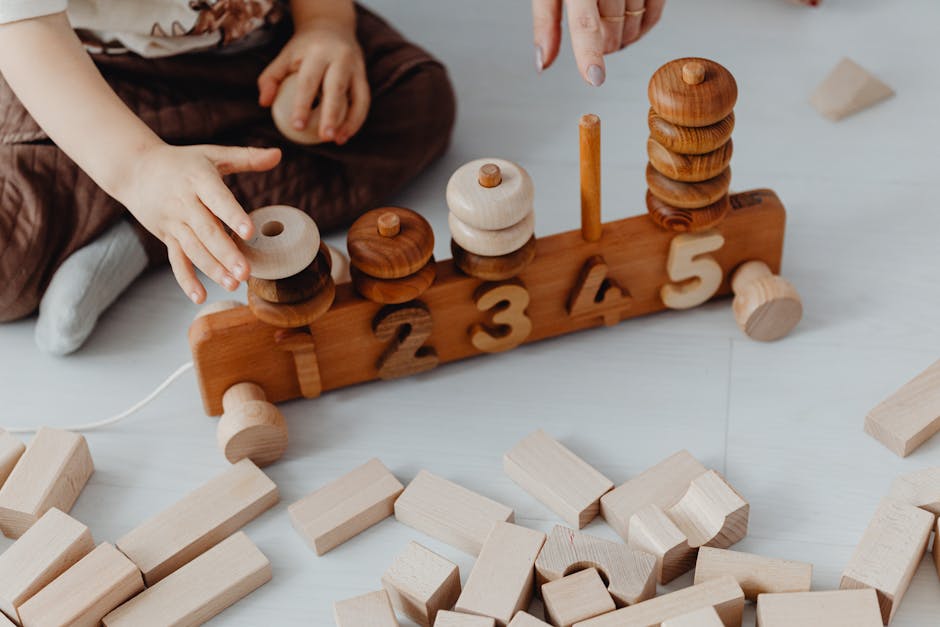
2Explore & Plan 8 min
Have your child physically explore the items. Ask them to pick up a few things and describe what they see, feel, and notice. Guide them to identify different characteristics, also called 'attributes'. An attribute is a quality or characteristic of something, like its color, size, or how it feels (soft/hard). Identifying attributes helps us describe and compare things. Then, encourage them to suggest ways to group the items.
Ask: "Pick up some things. What do you notice about them?"
Ask: "Can you find something soft? What about something round?"
Ask: "How are these two things different?"
Ask: "How could we start making groups with these?"
Done when your child identifies at least two different attributes of the objects (e.g., color, size, type) and suggests a way to group them.
Know Before You Teach
- Good to know: Attributes are features an object has, like its color, shape, size, texture (how it feels), or what it's made of.
- Recognizing multiple attributes in objects is a step toward more complex classification.
- It's working when: Your child using descriptive words like 'big', 'small', 'blue', 'soft', or 'hard' when talking about the items.
- If they're stuck: Pick up an item, describe one attribute (e.g., 'This button is round'), and ask, 'What else do you notice about it?'
- Easier: Focus on just one obvious attribute, like asking 'Can you find all the red things?' or 'Can you find all the smooth things?'
- Harder: Ask your child to find two items and describe three ways they are different, or two ways they are the same.
Done when: Student identifies at least two different attributes of the objects (e.g., color, size, type) and suggests a way to group them.

3Discussion 6 min
Build on your child's observations from the previous stage. Guide them to articulate a 'sorting rule' for potential groups. A sorting rule is the characteristic we decide to use to put things into groups. For example, if you put all red things together, the rule is 'color'. This helps us organize consistently. Let them answer first; gently guide if they get stuck.
Ask: "If we put all the red things together, what would we call that group?"
Ask: "What about putting all the small things together?"
Ask: "What is the rule for that group?"
Done when your child can explain a simple sorting rule in their own words (e.g., 'put all the red ones together').
Know Before You Teach
- Good to know: A sorting rule is the specific characteristic chosen to group items, ensuring that every item in a group shares that characteristic.
- Articulating the rule helps children think logically and apply consistent criteria.
- Rules can be simple, like 'all the blue ones,' or more complex, like 'all the toys that roll.'
- If they ask: Why do we need a rule? A rule helps us make sure everyone knows why things are in a certain group, and it helps keep our groups neat!
- It's working when: Your child using a phrase like 'all the...' or 'only the...' to describe a potential group.
- If they're stuck: Suggest a group (e.g., 'What if we put all the things that are soft together?') and then ask, 'What would the rule be for that group?'
- Easier: You can offer two clear choices for a rule (e.g., 'Should we sort by color or by type of item?').
- Harder: Ask them to think of a sorting rule that would create exactly two groups, with no items left over.
Done when: Student can explain a simple sorting rule in their own words (e.g., 'put all the red ones together').

4Activity 9 min
Provide the empty bowls for sorting and the mixed items (small toys, socks, buttons). Instruct your child to take the lead in sorting the items into distinct groups. Encourage them to choose a sorting rule, like color or type. Observe their sorting method and ask guiding questions to understand their choices, without correcting immediately.
Ask: "What rule will you use to sort first?"
Ask: "Why did you put that one there?"
Ask: "Is there another way we could group these?"
Done when your child has completed the physical sorting of items into distinct groups based on at least one attribute.
Know Before You Teach
- Good to know: This stage allows children to put their planning into action and see the results of their chosen rule.
- Observing their sorting allows you to understand their current logical thinking and identify any misconceptions.
- If they ask: Is this right? You chose your rule, so if it makes sense to you, then yes! What rule are you using for this group?
- It's working when: Your child purposefully placing items into separate bowls, even if one or two items are initially misplaced.
- If they're stuck: Start sorting the first two items yourself based on a simple rule (e.g., 'I'm going to put all the red things here') and ask them to continue.
- Easier: Provide bowls pre-labeled with pictures or colors (e.g., a red bowl for red items, a blue bowl for blue items).
- Harder: After they sort by one rule, ask them to mix everything up and sort again using a completely different rule this time.
Done when: Student has completed the physical sorting of items into distinct groups based on at least one attribute.

5Summary 2 min
Celebrate your child's accomplishment in sorting the items. Ask them to explain their final sorted groups. Connect the concept of sorting to real-world examples, like organizing toys or clothes, and discuss why it's helpful.
Ask: "Why is it helpful to sort things in our homes?"
Ask: "What was your favorite way to sort today?"
Ask: "Can you tell me about your sorted groups?"
Done when your child shares one key takeaway or a favorite part about sorting.
Know Before You Teach
- It's working when: Your child pointing to their sorted groups and using a descriptive word or phrase to explain them (e.g., 'These are all the buttons').
- Easier: You can describe one of their groups (e.g., 'You put all the socks here!') and ask, 'Is that right?'
- Harder: Ask them to think of one new item they own (e.g., a ball) and tell you which of their sorted groups it would fit into and why.
Done when: Student shares one key takeaway or a favorite part about sorting.
Beyond The Spark
Fuel their curiosity beyond the Spark with bonus extras.
Table Talk
People sort things all the time, like when a librarian puts books back on the shelf or a chef organizes ingredients in the kitchen.
Challenge
Try sorting the items again using a completely different rule! Maybe sort by soft/hard, or things that roll/don't roll.
Quick Recap Quiz 4 min
Customize this quiz, add questions, or follow your child's lead! Each question has a 'Parent Tip' to help them find the answer without giving it away.
1. Which pile is sorted by color?
- A pile with red and blue toys together.
- A pile with only red toys.
Ask: 'Which pile has all the same colors?'
2. What is a good way to sort different kinds of toys?
- Put all the cars together, and all the blocks together.
- Mix all the cars and blocks into one pile.
Ask: 'If you want to find your car quickly, how should you put them away?'
3. Why do we sort our clothes when we put them away?
- To make a big, messy pile.
- To find them easily when we need them.
Ask: 'If all your shirts and pants were mixed up, would it be easy to get ready?'
4. If you sort a bowl of fruit, how might you put them into groups?
- By what kind of fruit they are (apples, bananas, oranges).
- Mix them all up in one big group.
Ask: 'If you want just an apple, where would you look?'
Loved This Spark?
Scan to jump into the app and explore similar Sparks in our Sparks Hub. New to Mai? Start free with 10 Sparks, no credit card needed.