The Great Float-or-Sink Challenge!
Embark on a hands-on adventure to uncover why some objects float and others sink! You'll make predictions, conduct experiments with everyday items, and even make a sinking object float, discovering the secret science of density along the way.
Our goal: Learners will understand the fundamental principles of buoyancy and density through hands-on experimentation. They will be able to confidently predict whether objects will float or sink and apply their knowledge to make a 'sinking' object float.
What You Need
Clear drinking glasses • Tap water • Table salt • Large raw egg • Spoon • Small objects for testing
and this is just the baseline.
Scan to jump into the app and easily personalize this Spark to match your child's exact learning level and see how Mai will guide this lesson.
Learning Guide
A simple guide to lead you through the kickoff, the core challenge, and everything in between.
Mai’s Tips
- The 'why' matters: When testing objects, don't just ask if it floats or sinks. Ask why they think it will happen. This trains their prediction skills and surfaces their current understanding (or misunderstanding) of density. For example, 'Why do you think that big piece of wood will float?' or 'Why do you expect the tiny pebble to sink?'
- Observational nuances: Encourage children to describe how things float or sink. Does it float high or low? Does it sink fast or slowly? Does it spin? These observations, especially for older children, can hint at differences in density and shape, adding depth to their understanding.
- Simplifying density: If the term 'density' is too abstract, you can use phrases like 'how much stuff is squeezed into it' or 'how packed together its parts are.' For very young children, simply observing 'floaty' and 'sinky' and noticing patterns is a great start.
- Mess alert: Be ready for some splashes! Keep paper towels handy. The salt water is harmless but can leave residue if not wiped up. Remember to wash hands thoroughly after handling the raw egg.
For The Grown-Up
- Watch out: When making the egg float, if you just dump a lot of salt in without stirring, the salt will just sit at the bottom and the egg might not float. You need to stir thoroughly to dissolve the salt and distribute the density evenly.
- A common mix-up: Heavier objects always sink, lighter objects always float, and bigger objects always sink.
- Try this: Before introducing the concept of density, offer a large, light object (like a big dry sponge or a piece of cork) and a small, heavy object (like a coin or a small stone). Ask the child to predict which will float and which will sink, then test. This will directly challenge the intuitive idea that 'heavy means sink' or 'big means sink' without considering the amount of space it takes up.
- Explain it like this: Think of density like how crowded a bus is. A bus packed full of people (dense) will feel heavier than an empty bus (less dense), even if they're the same size. If the road was water, the 'full' bus would sink lower than the 'empty' one.
- A big question to ask: If a giant cruise ship made of heavy steel floats on the ocean, but a tiny metal coin sinks to the bottom, what does that tell us about density that's more than just 'heavy' or 'light'?
Prep Before Session 5 min
- Gather 2-3 clear glasses, tap water, table salt, a spoon, and one raw egg.
- Collect 4-6 small household objects that you suspect will have different densities (e.g., grape, coin, bottle cap, piece of apple, cork, small plastic toy).
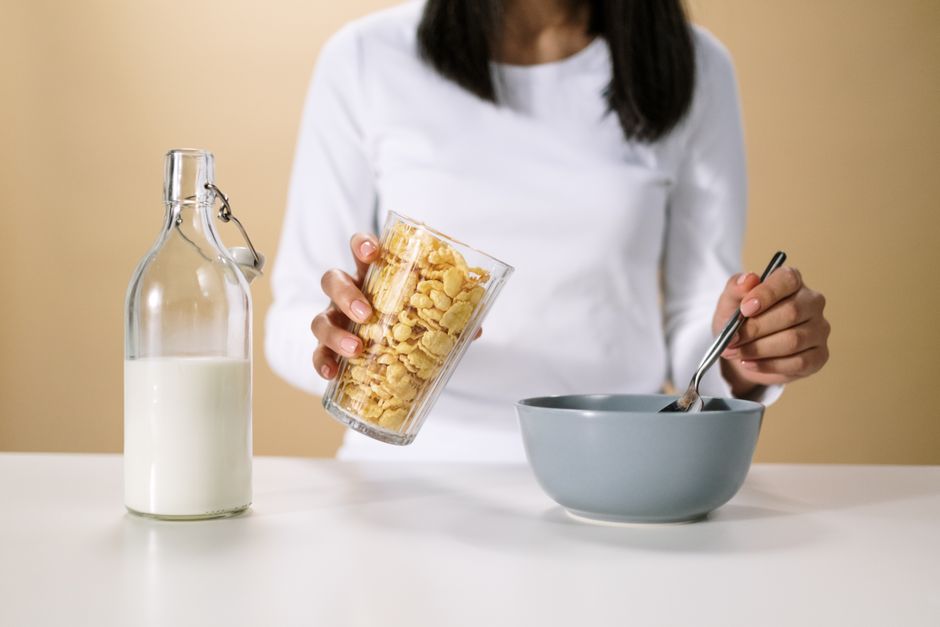
1Introduction - Breakfast Buoyancy 4 min
Start by having the children observe common breakfast items. Guide younger children to point out floating/sinking items. Encourage older children to offer initial thoughts on why they think things float or sink. The goal is to spark curiosity and activate prior knowledge.
Know Before You Teach
- If they ask: Why do bubbles float? Bubbles float because they are filled with very light air, which is much less dense than the liquid around them.
- Key words: float: to stay on top of the water
- Key words: sink: to go down to the bottom of the water
- It's working when: The child actively pointing out items and articulating simple observations or predictions about floating/sinking.
- If they're stuck: Suggest they gently nudge a floating item to see how it moves, or ask them to describe the difference between two items, one floating and one sinking.
- Easier: Focus only on whether items stay on top or go to the bottom, without asking for 'why'.
- Harder: Ask them to categorize items based on their floating behavior and explain any patterns they notice.
Done when: Student points out at least one floating and one sinking item and offers an initial thought about why.

2Explore & Plan - The Prediction Ponder 7 min
Lay out the collected small objects and clear glasses with water. Have the children predict for each object whether it will float or sink. Encourage them to explain their reasoning before testing. Then, let them test each item and observe.
Know Before You Teach
- Good to know: Initial predictions might be based on intuition rather than scientific understanding (e.g., bigger sinks, heavier sinks).
- Testing predictions is a key part of the scientific method.
- If they ask: What if an object is just right in the middle? That means its density is almost exactly the same as the water! It's perfectly balanced.
- Key words: predict: to guess what will happen before it does
- It's working when: The child making clear, confident predictions and showing curiosity when results are unexpected.
- If they're stuck: Guide them through a side-by-side comparison: 'Look at the grape and the cork. Which one do you think is heavier for its size?'
- Easier: Provide fewer objects for testing (2-3) and focus purely on observing the outcome.
- Harder: Encourage them to record their predictions and results (e.g., drawing a simple chart or writing down 'float'/'sink').
Done when: Student has predicted and tested at least 3-4 objects, observing the results.

3Discussion - Unpacking the Density Secret 7 min
Review the test results, then introduce density: how much 'stuff' is packed into a space. Denser objects sink, less dense objects float. Give examples like pebbles and logs. Ask guiding questions to apply this new understanding.
Know Before You Teach
- If they ask: What about an ice cube? Water freezes, so why does ice float in water? That's a great observation! When water freezes into ice, it actually expands, making it slightly less dense than liquid water, which is why ice floats!
- It's working when: The child using the word 'density' (even if imperfectly) to explain a floating or sinking phenomenon, or suggesting a way to change density.
- If they're stuck: Revisit the 'pillow vs. rock' analogy or the 'crowded bus' metaphor. 'Which one has more stuff packed into the same space?'
- Harder: Challenge them to explain why a large, hollow plastic ball floats while a tiny metal BB sinks, using the concept of density.
Done when: Student can explain in their own words why some objects float and others sink, relating it to density, and suggests how to change water's density.
4Activity - The Floating Egg Mission! 9 min
Guide the children to make an egg float in water using salt. Have them pour water, place the egg (it sinks), then add salt spoon by spoon, stirring thoroughly, until the egg floats. Ask them to explain what's happening.
Know Before You Teach
- Good to know: Adding salt to water increases the water's density.
- If they ask: Why does the salt disappear? The salt crystals break down and spread out evenly throughout the water, mixing in so thoroughly that you can't see them anymore. They are dissolved.
- It's working when: The child actively stirring and observing the egg's change in buoyancy, showing excitement when it floats.
- If they're stuck: Ensure they are adding enough salt and stirring completely. 'Keep stirring until all the salt disappears. Do you see the egg moving yet?'
- Easier: Focus on the magical transformation of the egg floating, and less on the exact amount of salt needed.
- Harder: Challenge them to find the minimum amount of salt needed to make the egg just barely float, or to make it hover mid-water.
Done when: The egg successfully floats in the saltwater solution, and the student can explain why.

5Summary - Real-World Floaters 3 min
Celebrate their achievement. Ask reflection questions about what they learned and where they see density in the real world. Encourage them to connect the experiment to everyday observations.
Know Before You Teach
- Good to know: Density principles are applied in many real-world contexts, from shipbuilding to oceanography.
- The lesson reinforced the scientific method: predict, test, observe, explain.
- If they ask: Why does a hot air balloon float? Just like a less dense egg floats in denser water, hot air is less dense than the cooler air outside the balloon. That's why it rises!
- It's working when: The child making connections between the experiment and other real-world examples of floating/sinking.
- If they're stuck: Suggest examples like submarines or boats and ask them to explain how density applies.
- Harder: Ask them to brainstorm a new experiment they could do at home to explore density further.
Done when: Student shares one key takeaway from the lesson about density or floating/sinking.
Beyond The Spark
Fuel their curiosity beyond the Spark with bonus extras.
Table Talk
Understanding density helps engineers design ships, submarines, and even hot air balloons to either float or sink as needed.
Did You Know?
Did you know that the Dead Sea is so salty and dense that you can float on your back without even trying, just like a cork?
Challenge
Try to make an egg hover exactly in the middle of the water, not quite touching the bottom or the top, by carefully adjusting the amount of salt.
Quick Recap Quiz 4 min
Customize this quiz, add questions, or follow your child's lead! Each question has a 'Parent Tip' to help them find the answer without giving it away.
1. You put a small grape in water and it sinks. Then you put a big piece of cork in water and it floats. Why?
- Because big things always float.
- Because the cork is less dense than the grape.
Focus on density, not just size or weight. Density is about how much 'stuff' is packed into a space.
2. To make an object that usually sinks (like an egg) float in water, what change did you make to the water?
- You added salt to make the water denser.
- You made the water colder.
Remind them that adding salt makes the water heavier for its size.
3. If you have a toy boat made of plastic that floats, but then you fill it with rocks, it sinks. What happened?
- The boat became more dense than the water.
- The boat became less dense than the water.
Even though the boat itself floats, adding heavy rocks increases its overall density, making it sink.
4. Imagine you are a submarine! To dive deep into the ocean, what would a submarine do?
- It would take in water to become denser.
- It would push out water to become less dense.
Submarines change their density by taking in or expelling water from special tanks.
Loved This Spark?
Scan to jump into the app and explore similar Sparks in our Sparks Hub. New to Mai? Start free with 10 Sparks, no credit card needed.