
The Dreidel's Secret Spin
Today is Hanukkah, the Festival of Lights! We'll explore the magic of chance and probability using a traditional dreidel. This hands-on activity challenges families to predict, spin, and discover the hidden patterns in seemingly random events, connecting it to stories of resilience and hope.
Our goal: Children will learn to predict what might happen before spinning a dreidel and how to collect data from repeated trials. They will then be able to explain in simple terms that even random events can show patterns, connecting this to the idea of probability.
What You Need
Spoon • Dreidel • Paper • Pen/pencil
and this is just the baseline.
Scan to jump into the app and easily personalize this Spark to match your child's exact learning level and see how Mai will guide this lesson.
Learning Guide
A simple guide to lead you through the kickoff, the core challenge, and everything in between.
Mai’s Tips
- Active observation: The goal of spinning the dreidel many times is not just to play, but to gather data. Emphasize that each spin is an independent event, but over many spins, patterns related to probability emerge. This is crucial for understanding the concept.
- Beware the 'luck' trap: Children often believe in 'lucky' sides or that if a side hasn't come up recently, it's 'due' to appear. This is the Gambler's Fallacy. When discussing results, gently guide them away from attributing outcomes to luck and towards discussing frequency and likelihood over many trials.
- Simplify for younger kids: For younger children, focus on 'more likely' and 'less likely' rather than specific percentages or fractions. The key is for them to observe that outcomes aren't always equal and some happen more often than others, especially with a lopsided spinner like a dreidel.
1Spinning Surprises at Breakfast 5 min
Start with a common breakfast item to introduce the idea of unpredictable outcomes, then transition to the dreidel. Have the child find a spoon or similar item and spin it, observing how it lands.
Know Before You Teach
- Good to know: Hanukkah is a Jewish holiday celebrated for eight nights and days.
- A dreidel is a four-sided spinning top played during Hanukkah.
- Spinning objects can have unpredictable outcomes.
- If they ask: What are the letters on the dreidel? They are Hebrew letters: Nun, Gimel, Hei, Shin. Together they stand for 'Nes Gadol Haya Sham' – A great miracle happened there.
- Key words: Hanukkah: A Jewish holiday celebrating a miracle and the rededication of the Temple.
- If they're stuck: Try spinning different breakfast items (e.g., a cup, a small box) to highlight the variety of unpredictable outcomes.
- Easier: Focus on simply observing if the spoon lands the same way or not without needing a 'why'.
- Harder: Ask an older child to predict if a spoon or a coin would be more predictable, and why.
Done when: Child has spun an item and observed its unpredictable landing, ready to discuss the dreidel.
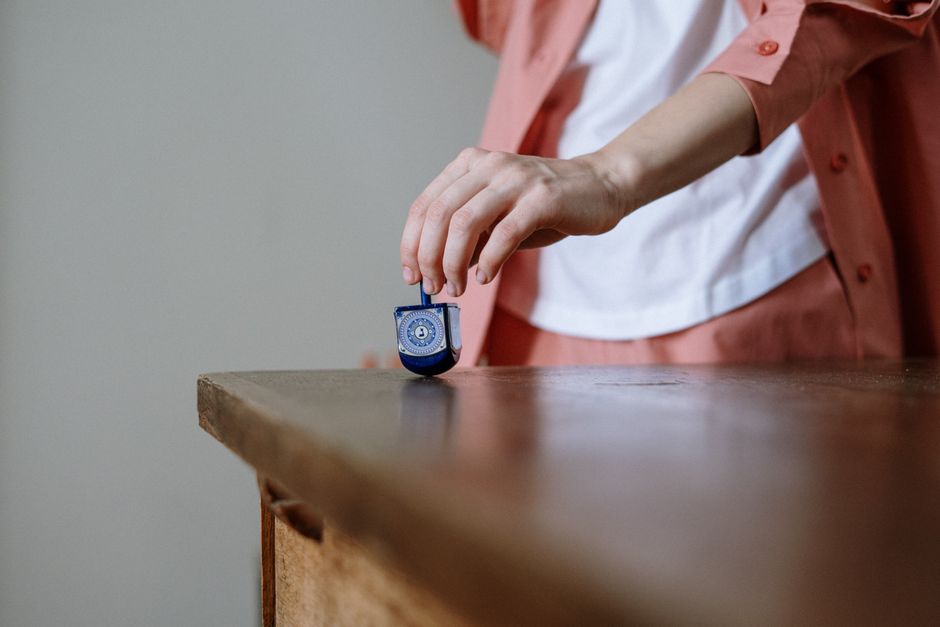
2Explore & Plan: The Dreidel's Dance 8 min
Introduce the dreidel and its Hebrew letters. Encourage predictions about which side it will land on, and plan how to record results. Younger children can identify letters, older children can articulate their predictions more formally.
Know Before You Teach
- Good to know: The physical design of a dreidel (its weight distribution, shape) can subtly influence its spin outcomes, though it's largely random.
- Thinking about how to test a prediction is a key scientific skill.
- If they ask: Which letter makes you win? Gimel usually means you take everything from the pot in the game.
- If they're stuck: Have them spin the dreidel once or twice just to see what happens, then revisit the prediction.
- Easier: Focus only on identifying the four different letters on the dreidel.
- Harder: Ask an older child to consider if the way they spin the dreidel might affect which side it lands on.
Done when: Child has examined the dreidel, made a prediction, and helped plan a method to record spin outcomes.

3Discussion: What is Probability? 6 min
Discuss their initial observations and predictions. Introduce the core concept of 'probability' in simple terms, using examples they can relate to. Then, apply the concept to a new scenario.
Know Before You Teach
- Good to know: Probability is usually expressed as a number between 0 and 1 (or 0% and 100%), where 0 means impossible and 1 means certain.
- For a fair, four-sided dreidel, the theoretical probability of landing on any one side is 1/4 or 25%.
- Many real-world situations involve probability, from weather forecasts to game outcomes.
- If they ask: Is there a trick to make it land on one side? Not really! That's what makes it a game of chance. Even if you spin it the same way, tiny differences can make it land differently. That's why we call it 'random'.
- Key words: Chance: The possibility of something happening, without being able to predict it exactly.
- It's working when: Child grasping the general idea of 'more likely' vs. 'less likely' without relying on specific numbers.
- If they're stuck: Use a simple 'bag of toys' analogy: 'If I have 3 red cars and 1 blue car in a bag, which color car is more likely to come out if I just grab one?'
- Easier: Focus on the idea that some things are 'more likely' and others are 'less likely', rather than assigning numbers to them.
- Harder: Ask an older child: 'If you could change the dreidel to have more 'Gimel' sides, how would that change the probability?'
Done when: Student can explain the core concept of probability (likelihood/chance) in their own words and apply it to a new, simple scenario.

4Activity: Dreidel Data Collection 9 min
Guide the child in creating a tally chart and spinning the dreidel a set number of times (e.g., 20-50). Younger children can make tally marks; older children can help count and perhaps estimate percentages.
Know Before You Teach
- Good to know: The more trials (spins) you do, the closer your observed results (experimental probability) will typically get to the theoretical probability.
- Tally marks are a simple way to collect data quickly.
- Collecting data helps to move from assumptions to evidence-based understanding.
- Key words: Tally chart: A way to count things using lines or marks.
- Key words: Data: Information or facts collected during an experiment.
- If they're stuck: Simplify the task: reduce the number of required spins to 10-15, or help them make the tally marks.
- Easier: Let the child focus on just making a mark for each letter, without worrying about total count or percentages yet.
- Harder: Ask an older child to estimate what percentage of spins they expect for each side before starting, then compare with results.
Done when: Student has completed spinning the dreidel and recorded all the outcomes on their tally chart.

5Summary: The Story Our Spins Tell 2 min
Review the collected data, identifying which letter appeared most and least often. Connect the findings back to the concept of probability and the Hanukkah story. Younger children can identify the longest tally bar; older children can discuss reasons for patterns.
Know Before You Teach
- Good to know: Comparing predictions to actual results is a fundamental part of scientific inquiry.
- Understanding probability helps us interpret information and make informed decisions in daily life.
- If they ask: Why didn't my favorite letter come up the most? Even if you wish for a letter, the dreidel doesn't know! It's all about chance, and sometimes your favorite isn't the most likely, or it just didn't come up as much in this particular experiment.
- If they're stuck: Help them count the tallies for each letter, then ask 'Which number is bigger?'
- Easier: Just celebrate the act of counting and seeing which column is the longest.
- Harder: Ask an older child to calculate the observed probability (as a fraction or percentage) for each side based on their data.
Done when: Student can share one key takeaway about the dreidel's spin results and relate it to probability.
Beyond The Spark
Fuel their curiosity beyond the Spark with bonus extras.
Table Talk
Understanding probability helps scientists predict weather, doctors understand risks, and even helps game designers make fair games.
Did You Know?
The four letters on a dreidel (Nun, Gimmel, Hei, Shin) stand for 'A great miracle happened there,' referring to the Hanukkah story!
Challenge
Design your own spinner with different sized sections for each outcome. Predict which outcome will be most likely, then test your design by spinning it many times and recording the results.
Quick Recap Quiz 4 min
Customize this quiz, add questions, or follow your child's lead! Each question has a 'Parent Tip' to help them find the answer without giving it away.
1. What is probability about?
- Who wins a game every time
- How likely something is to happen
Remind them of the definition of probability and how it applies to our spinning experiment.
2. If you spin a dreidel 20 times and Nun comes up 10 times, what does that mean?
- Nun is the luckiest side
- Nun had a high chance of appearing
Focus on the idea that frequency of an outcome indicates higher probability, not 'luck'.
3. If a bag has 1 red ball and 9 blue balls, which color are you most likely to pick?
- Red
- Blue
Ask them to think about which color has more choices in the bag.
4. Why is it important to spin a dreidel many times to understand its probability?
- To see the patterns over time
- To make sure every side gets a turn
Guide them to remember that probability reveals itself over many trials, not just one or two spins.
Loved This Spark?
Scan to jump into the app and explore similar Sparks in our Sparks Hub. New to Mai? Start free with 10 Sparks, no credit card needed.