
Sweet Ratio Challenge
This lesson challenges learners to apply mathematical ratios and proportions to a real-world scenario: scaling a recipe. Students will transform a simple recipe to serve a different number of people, understanding how ingredient quantities change proportionally. It's a delicious way to master essential math skills!
Our goal: In this spark, your learner will apply proportional reasoning to scale recipe ingredients up or down, accurately calculate and measure ingredient quantities based on a desired serving size and understand the importance of precision and ratio relationships in practical contexts.
What You Need
Measuring Cups • Measuring Spoons • Paper • Pen Or Pencil • Recipe Ingredients • Simple recipe • Measuring tools
and this is just the baseline.
Scan to jump into the app and easily personalize this Spark to match your child's exact learning level and see how Mai will guide this lesson.
Learning Guide
A simple guide to lead you through the kickoff, the core challenge, and everything in between.
Mai’s Tips
- Encourage your child to verbalize their calculations before measuring. This helps solidify the math in their mind and allows you to gently correct any errors.
- If fractions are a stumbling block, suggest drawing out the measurements (e.g., dividing a cup into halves, then quarters) or using visual aids to make the proportional changes more concrete.
Prep Before Session 10 min
- Gather common measuring cups (1 cup, 1/2 cup, 1/4 cup, 1/3 cup) and spoons (tablespoon, teaspoon).
- Have 2-3 simple, kid-friendly recipe options printed or available (e.g., pancakes, cookies, fruit dip).
1Introduction 5 min
Begin by introducing the idea of adjusting recipes. Ask: 'Have you ever noticed how different recipe sizes are, like for a small family versus a big party?' Encourage them to think about how math is used in cooking. Then ask: 'What kind of math do you think chefs use all the time?' Introduce the terms ratios and proportions. A ratio is a comparison of two amounts, for example, 1 cup of flour to 2 eggs. You see ratios when recipe ingredients are listed. Proportions are when two ratios are equal, meaning you adjust all ingredients by the same factor – scaling up (multiplying) or scaling down (dividing) – to keep the recipe balanced. This skill is vital for chefs to ensure dishes taste right every time.
Done when the child shows curiosity and grasps the basic idea of adjusting recipe sizes.
Know Before You Teach
- Good to know: Ratios compare two amounts, showing their relationship, like 1:2 for flour to eggs.
- Proportions are about keeping the relationships between ingredients the same, even when amounts change.
- If they ask: Why is it called a 'Sweet Ratio Challenge'? Because you'll use ratios to make something sweet (or savory) in the kitchen, and it will be a fun challenge.
- If they ask: What if I don't like math? Cooking uses math in a practical way; you'll see how useful it is for something you enjoy making and eating.
- Key words: proportions: When two ratios are equal, meaning the relationship between quantities stays the same even if the amounts change.
- It's working when: Child volunteers an example of when a recipe size might need to change (e.g., 'for a big party' or 'just for myself').
- If they're stuck: Show them two different size boxes of cereal and ask which one they'd buy for a week-long trip with friends versus a quick breakfast alone.
- Easier: Provide a very simple recipe with only 2-3 ingredients and already state the scaling factor (e.g., 'we're going to double this recipe').
- Harder: Ask them to think of a time when not scaling a recipe correctly might cause a problem beyond just taste (e.g., running out of ingredients, wasted food).
Done when: Student shows curiosity and understands the basic premise of adjusting recipe sizes.

2Explore & Plan 8 min
Work with your child to choose a simple recipe they enjoy, such as pancakes, cookies, or a simple dip. Once a recipe is chosen, have them decide if they will double it to serve more people or halve it for a smaller treat. Guide them to plan their calculations. Ask: 'What's the first ingredient on your list?' 'How will you calculate its new amount?' 'What measuring tools will you need to make this recipe?' Encourage them to think ahead by asking: 'What part of this process do you think might be tricky?' Remember not to do the math for them, just help them organize their thoughts.
Done when the child has chosen a recipe, decided on doubling or halving, and written down a list of original ingredients and their newly calculated quantities.
Know Before You Teach
- Good to know: Common scaling factors for recipes are doubling (multiplying by 2) or halving (dividing by 2).
- Many recipes are designed to serve 4-6 people, so adjusting for 2 or 8-12 is common.
- If they ask: What if the recipe calls for 'a pinch'? For very small, unmeasured amounts like 'a pinch' or 'a dash', it's usually okay to just use a bit more or less by eye.
- If they ask: Can I just guess? In baking, precise measurements are usually very important because the chemical reactions depend on exact proportions for the recipe to turn out right.
- If they're stuck: Suggest starting with just one ingredient and calculating its new amount together to build confidence.
- Easier: Pre-select the recipe and the scaling factor (e.g., 'We're going to halve this cookie recipe').
- Harder: Ask them to consider a recipe that serves 3 people and scale it to serve 5, requiring a non-integer scaling factor.
Done when: Student has chosen a recipe, decided on scaling factor (double/half), and created a list of original and calculated new ingredient quantities.

3Discussion 6 min
Now that the planning is complete, discuss the mathematical process. Avoid formal math jargon unless your child uses it first. Ask: 'What operation did you use to figure out the new amount for each ingredient?' Then, focus on the scaling factor: 'If the original recipe served 4 people and you want it to serve 8, what's the relationship between those numbers?' Finally, address potential challenges: 'What if an ingredient was 1/2 cup and you needed to double it – how did you solve that?' Let your child explain their reasoning.
Done when the child can explain their calculation process for at least three ingredients and articulate the idea of multiplying or dividing by a constant factor.
Know Before You Teach
- If they ask: What's a 'constant factor'? It's the single number you multiply or divide all ingredients by to change the recipe size.
- If they ask: Why is it important that it's the same number for everything? Because if you change one ingredient more than another, the balance of the recipe gets thrown off, and it might not taste right or work properly.
- It's working when: Child clearly states 'I multiplied everything by two' or 'I divided everything by two' to explain their math.
- If they're stuck: Provide a concrete example with simple numbers, like 'If you have 4 apples and want twice as many, how many do you need?'
- Easier: Focus only on whole number scaling (doubling) and avoid fractions.
Done when: Student can explain their calculation process for at least three ingredients and articulate the idea of multiplying or dividing by a constant factor.
4Activity 9 min
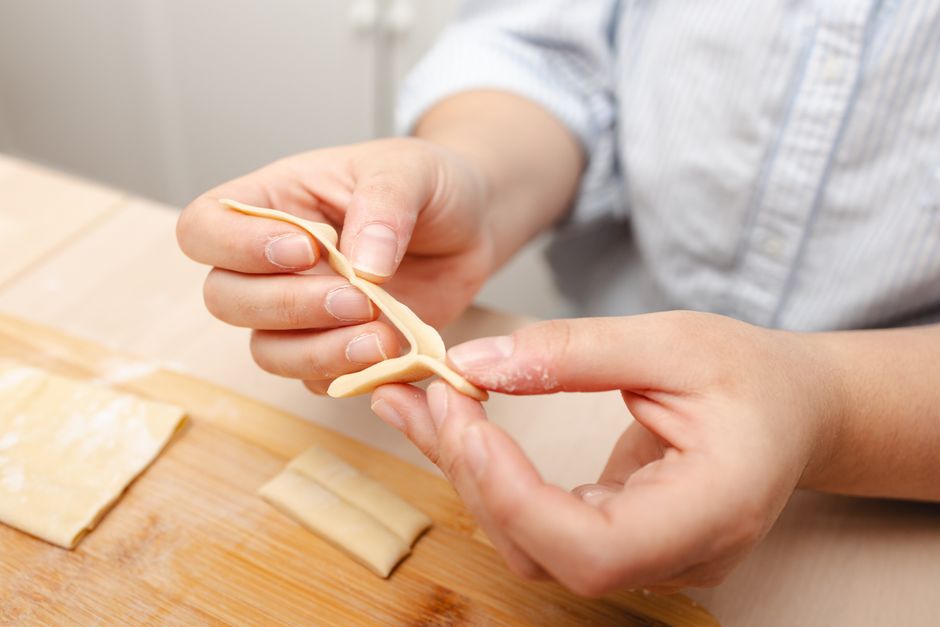
This is the hands-on part! Supervise carefully during the actual preparation, especially if kitchen appliances like a mixer or heat (stove/oven) are involved. Encourage precise measuring, reminding your child that small differences can change the outcome in baking. Prompt them with questions like: 'Are you sure that's exactly half a cup, or is it a little more?' or 'What happens to the taste or texture if you add too much of this ingredient?' Let your child take the lead in measuring out all the ingredients according to their newly calculated amounts and then combine them in the correct order.
Done when the child has successfully measured and combined all ingredients for their scaled recipe and is ready for the next step (e.g., baking, cooking, chilling).
Know Before You Teach
- Good to know: Measuring liquids requires looking at the meniscus (the curve of the liquid) at eye level for accuracy.
- Measuring dry ingredients like flour often involves leveling off the top with a straight edge.
- If they ask: Does it really matter if it's a tiny bit more? In baking, yes, often even small differences can change the texture, rise, or overall success of the final product.
- If they ask: Why do some recipes say 'packed' brown sugar? 'Packed' means pressing the sugar into the measuring cup to remove air, which ensures a consistent, accurate amount.
- It's working when: Child carefully uses measuring tools and tries to level off dry ingredients or correctly read liquid measurements.
- If they're stuck: Demonstrate how to measure one ingredient very precisely (e.g., leveling flour, eye-level for liquid) and have them try the next one.
- Easier: Focus on ingredients that are easier to measure precisely (e.g., whole cups/spoons, liquids) and supervise more closely.
- Harder: Ask them to convert a measurement from a recipe (e.g., 1/4 cup) to a smaller unit if they need to scale it down further (e.g., how many tablespoons is 1/4 cup?).
Done when: Student has successfully measured and combined all ingredients according to their scaled recipe and is ready for the next step (e.g., baking, cooking, chilling).

5Summary 2 min
Celebrate your child's fantastic effort and the tangible result of their math work in the kitchen! Ask them to reflect on the entire process. Prompt them with questions like: 'What was the hardest part about scaling this recipe, and how did you overcome it?' 'What did you learn about the importance of being precise when measuring ingredients?' Finally, think bigger: 'How might this skill of scaling proportions be useful in other parts of your life, beyond cooking and baking?'
Done when the child shares one key takeaway or a real-world application of scaling and proportions.
Know Before You Teach
- Good to know: The skill of scaling proportions is used in many fields beyond cooking, such as construction, engineering, art, and medicine.
- For example, architects scale blueprints for buildings, and pharmacists scale medication dosages.
- Being precise with measurements and calculations ensures desired outcomes and prevents waste or errors.
- If they ask: So, like, could I use this math to build a model car? Yes, you would need to scale down the measurements of a real car to make a perfectly proportioned model.
- If they ask: What if I mess up sometimes? That's okay! Learning often involves trial and error; the important thing is understanding the process and trying again.
- It's working when: Child spontaneously mentions something they found challenging or something they learned about the importance of math.
- If they're stuck: Provide a specific scenario, 'Imagine a painter mixing a specific color for a whole house; how would they use ratios?'
- Easier: Simply ask, 'What was your favorite part of this activity?'
- Harder: Challenge them to think of a job or hobby where precise scaling is absolutely critical and why (e.g., designing bridges, creating perfume).
Done when: Student shares one key takeaway or a real-world application of scaling/proportions.
Beyond The Spark
Fuel their curiosity beyond the Spark with bonus extras.
Table Talk
Chefs, bakers, food scientists, and even pharmacists use ratios and proportions daily to ensure precise quantities in their work.
Challenge
Try scaling the recipe by 1.5 times or by one-third. This introduces more complex fractional calculations! You could also research a different culture's traditional recipe and adjust it for your family.
Quick Recap Quiz 4 min
Customize this quiz, add questions, or follow your child's lead! Each question has a 'Parent Tip' to help them find the answer without giving it away.
1. If a recipe calls for 2 cups of flour and you want to double the recipe, how much flour do you need?
- 2 cups
- 4 cups
Remind them that 'doubling' means multiplying by two.
2. A recipe uses 1/2 cup of sugar. If you want to halve the recipe, how much sugar should you use?
- 1/4 cup
- 1 cup
Halving 1/2 means dividing by 2, or finding half of a half.
3. When scaling a recipe, why is it important to change ALL ingredients by the same proportion (e.g., double everything, or halve everything)?
- It only matters for the main ingredients like flour or sugar.
- To maintain the correct flavor balance and texture of the dish.
Discuss how changing only some ingredients would affect the taste and consistency of the final product.
4. Besides cooking, where else might you use the math skill of scaling proportions?
- Designing buildings, mixing paints, or making chemical solutions.
- Only when you're measuring your height or weight.
Think about situations where you need to adjust quantities of multiple items at the same rate.
Loved This Spark?
Scan to jump into the app and explore similar Sparks in our Sparks Hub. New to Mai? Start free with 10 Sparks, no credit card needed.