Sound Blend Hunt
Become a word detective! This lesson challenges children to identify and sort initial consonant blends in words, sharpening their ear for sounds and boosting reading fluency. It's a hands-on adventure into how letters team up to make unique sounds at the beginning of words.
Our goal: Learners will discover how groups of letters work together to create unique sounds at the beginning of words. They will practice identifying these 'blend' sounds and sorting words, which will help them read new and challenging words more easily.
What You Need
Cereal box • Old magazines/newspapers • Child-safe scissors • Paper • Pen/marker • Glue stick
and this is just the baseline.
Scan to jump into the app and easily personalize this Spark to match your child's exact learning level and see how Mai will guide this lesson.
Learning Guide
A simple guide to lead you through the kickoff, the core challenge, and everything in between.
Mai’s Tips
- Focus on sound: The goal is for children to hear the individual consonant sounds within the blend. If they're struggling, exaggerate the sounds of 'b-l' or 's-t' distinctly before blending them smoothly. This helps their phonological awareness.
- Common misconception: Children might confuse blends with digraphs (like 'sh', 'ch', 'th') where two letters make one new sound. Reiterate that for a blend, you can still hear both original sounds, just very close together. An incorrect sort shows they're still distinguishing sounds, which is progress.
- Simplify if needed: If a child is overwhelmed, start with just two highly contrasting blends (e.g., 'bl' and 'gr') and fewer words. You can also pre-sort a few examples together to model the process before they go solo.
- For reluctant readers: Let them draw pictures for words they can't quite read but can identify by sound, or have older siblings help read the words for sorting. The focus is on the sound identification, not perfect reading.
1Breakfast Word Hunt 5 min
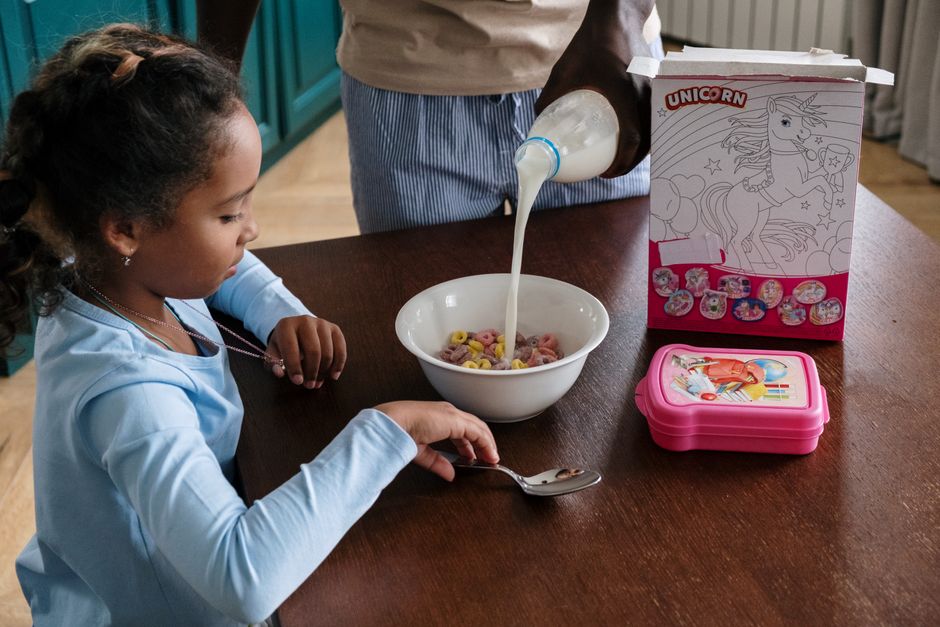
Begin by sitting at the breakfast table with the child and pointing to words on a cereal box or other breakfast items. Guide them to identify individual beginning sounds, then words with two sounds that blend together. Encourage them to listen carefully.
Know Before You Teach
- Good to know: The goal here is to get them listening, not to introduce the formal term 'blend'.
- If they ask: What's a blend? It's like two sound friends working together at the start of a word, and you can still hear both of their voices!
- It's working when: Child attempts to vocalize initial sounds of words, even if imperfectly.
- If they're stuck: Point to words with very clear single initial sounds (e.g., 'apple', 'banana') first, then transition to simple blend words like 'bread' or 'toast'.
- Easier: Focus on just hearing the first sound of any word. Ask them to just point to words that start with 's'.
- Harder: Ask them to identify words that start with three consonant sounds, like 'str' in 'strawberry' or 'scr' in 'scratch'.
Done when: Child identifies a few words starting with single sounds and attempts to hear two distinct sounds at the beginning of a 'blend' word.

2Explore & Plan Our Blend Mission 8 min
Have the child gather materials for the word hunt. Discuss where words can be found and how they might organize their findings.
Know Before You Teach
- Good to know: This stage sets up the hands-on activity, encouraging children to think about resources and planning.
- It also builds agency by having them choose and organize materials.
- If they ask: Can I use my favorite book? Let's use old magazines or newspapers so we don't accidentally cut up a book you love to read! We want words we can cut out.
- It's working when: Child actively suggests materials or a plan, showing engagement.
- If they're stuck: Suggest specific items like 'an old newspaper?' or 'that box from the pantry?' to prompt ideas.
- Easier: Parent gathers all materials and asks the child to point to the 'word hunting paper' and the 'cutting tool'.
- Harder: Ask them to predict which blends they expect to find most often in the materials they've chosen.
Done when: Materials are gathered, and the child can suggest places to find words and a basic sorting strategy.

3Decoding Blends: The Secret Code 6 min
Define 'consonant blend' for the child, using examples from their breakfast table hunt. Emphasize that in a blend, both consonant sounds are heard, unlike digraphs where they make a new sound. Have them try to come up with new blend words.
Know Before You Teach
- Good to know: A consonant blend is two or more consonants together, where each letter's sound can still be heard (e.g., bl, st, gr, tr).
- The 'why' is that hearing these patterns helps in decoding unfamiliar words.
- If they ask: Is 'ch' in 'chair' a blend? That's a great question! In 'chair', the 'c' and 'h' team up to make one brand new sound, /ch/. For a blend, you can still hear both sounds, like /s/ and /t/ in 'star'. So 'ch' is not a blend.
- Key words: consonant blend: When two (or sometimes three!) consonant letters are next to each other, and you can hear both of their sounds, like 'bl' in 'blue'.
- If they're stuck: Provide examples of both blends and non-blends side-by-side (e.g., 'clap' vs. 'ship') and exaggerate the sounds for each, asking them to describe the difference they hear.
- Easier: Focus only on hearing the two distinct sounds in a blend, without contrasting with digraphs.
- Harder: Challenge them to explain why 'th' in 'think' is not a blend, but 'fl' in 'flower' is.
Done when: Student can explain what a consonant blend is in their own words and give one new example, applying the concept to a word not explicitly mentioned.

4Blend Sorting Challenge! 9 min
Guide the child in cutting out words and sorting them by initial consonant blends. Encourage them to sound out the words and listen for the blends. Supervise any use of scissors.
Know Before You Teach
- Good to know: Transfer of knowledge is key here: applying the blend concept to new words they find themselves.
- If they ask: What if a word has a blend, but I don't have a pile for it? That's a fantastic discovery! You can make a brand new pile for that blend. Write the blend on a piece of paper and start a new group!
- If they're stuck: Work together on one word, sounding it out and deciding the blend. Model how to listen for both sounds before placing it.
- Easier: Provide pre-written blend categories (e.g., 'BL', 'ST') and a smaller selection of words, some already cut out.
- Harder: Ask them to find words with blends in the middle or at the end of the word after mastering initial blends, or to categorize by specific types of blends (e.g., L-blends, R-blends).
Done when: Student has created at least two distinct piles of words, each beginning with a different consonant blend, and can explain why words belong in each pile.

5Our Blend Discoveries 2 min
Reflect on the activity, connecting the identification of blends to reading fluency. Celebrate their learning.
Know Before You Teach
- Good to know: Reflecting on learning solidifies the concepts and builds metacognitive skills.
- Connecting the skill to real-world reading provides motivation and meaning.
- If they ask: Will blends help me read really long words? Yes! If you can break a long word into smaller sound parts, like blends and other sounds, it becomes much easier to read the whole thing.
- It's working when: Child articulates how identifying blends can help them when encountering unfamiliar words.
- If they're stuck: Ask guiding questions like, 'Imagine you see a word you've never seen before, like 'g-l-o-w'. How could hearing the 'gl' help you?'
- Easier: Focus on naming their favorite blend they found and one word that uses it.
- Harder: Ask them to teach you about blends, explaining what they are and why they are important for reading.
Done when: Student shares one key takeaway about how identifying blends helps with reading or names a favorite blend they found.
Beyond The Spark
Fuel their curiosity beyond the Spark with bonus extras.
Table Talk
Recognizing blends helps you decode new words faster, making reading smoother and more enjoyable, whether it's a book or a recipe.
Did You Know?
Some words, like 'sprint' or 'splash', have three consonants blended together at the beginning!
Challenge
Create a 'Blend Story' using as many words as possible from your sorted piles. Can you make a story with at least 5 'st' words and 3 'bl' words?
Quick Recap Quiz 4 min
Customize this quiz, add questions, or follow your child's lead! Each question has a 'Parent Tip' to help them find the answer without giving it away.
1. Which of these words starts with a consonant blend?
- Cat
- Frog
Remind them to listen for two separate sounds at the beginning of the word.
2. The 'st' in 'stop' is an example of what?
- A consonant blend
- A vowel sound
Ask them if they can hear both the /s/ and /t/ sounds in 'stop'.
3. Which of these words would go in a 'gr' blend pile?
- Goat
- Grape
Encourage them to sound out both words and listen for the 'gr' blend.
4. Why is it helpful to know about consonant blends?
- It helps you read new words more easily.
- It helps you learn to count faster.
Connect it back to the idea of decoding and fluency.
Loved This Spark?
Scan to jump into the app and explore similar Sparks in our Sparks Hub. New to Mai? Start free with 10 Sparks, no credit card needed.