
Kitchen Potion Lab
Transform everyday kitchen ingredients into bubbling, colorful 'spooky potions' while exploring how different substances interact. This challenge encourages observation, prediction, and creative problem-solving.
Our goal: Learners will understand that mixing different ingredients can cause visible changes, like bubbling and fizzing, which are simple chemical reactions. They will practice observing these changes, making educated guesses about what will happen next, and use their observations to create their own unique 'potions'.
What You Need
Small clear cups • White vinegar • Baking soda • Liquid food coloring • Water • Dish soap • Oil • Teaspoons • Tray or baking dish
and this is just the baseline.
Scan to jump into the app and easily personalize this Spark to match your child's exact learning level and see how Mai will guide this lesson.
Learning Guide
A simple guide to lead you through the kickoff, the core challenge, and everything in between.
Mai’s Tips
- Observation is Key: The learning in this lesson comes from the children's active observation and prediction. Resist the urge to explain too much upfront. Let them try things, make a mess (contained by the tray!), and then ask them what they saw and why they think it happened. This builds their sense-making skills.
- Clarifying Reactions: Children often confuse simple mixing or dissolving with chemical reactions. When discussing, specifically ask: 'Did something new appear, like bubbles? Did it get hot or cold? Did the color change permanently?' This helps them differentiate between physical changes (like sugar dissolving in water) and chemical changes.
- Simplify for Younger Kids: If a younger child is struggling with the concept of 'chemical reaction', focus on the observable effect: 'Did it fizz?' or 'Did it make new colors that can't be unmixed?' The vocabulary can come later; the observation is the core.
- Contain the Chaos: Although spills are part of experimentation, placing all cups and the mixing station within a large tray or baking dish from the start will save you from major clean-up and allow children more freedom to experiment without constant 'be careful' reminders.
For The Grown-Up
- Watch out: Vinegar and baking soda reactions can overflow quickly, especially in narrow glasses. Use wide cups and place them on a tray or in a baking dish to catch spills.
- Watch out: Some food colorings, especially red and blue, can temporarily stain porous surfaces like unsealed countertops. Use a protective mat or wipe spills immediately. Turmeric powder as a substitute for yellow/orange food coloring will permanently stain.
- Try this: Encourage them to test various combinations, including those that do not react (like oil and water, or salt in oil). Ask them to predict what will happen before each mix, and then describe what they actually observe. This helps them see that not all mixtures lead to new substances, and that some substances don't mix at all.
- Explain it like this: Imagine your ingredients are like different toys in a toybox. Some toys (like water and juice) are very friendly and just blend in. Other toys (like oil and water) try to stay separate. And some special toys (like vinegar and baking soda) get so excited when they meet, they throw a fizzy party and make brand new, bubbly friends!
- A big question to ask: If you wanted to make a potion that fizzes non-stop, forever and ever, how would you do it? Is that even possible?
1Breakfast Table Potion Prep 5 min
Start by pointing to a glass of water, juice, or milk on the breakfast table. Engage the children in imagining how they could make it 'spooky' for Halloween, focusing on simple, safe transformations they might already know or imagine.
Know Before You Teach
- Good to know: This stage aims to activate prior knowledge about mixing and changing substances, however simple.
- It connects the activity to their immediate environment (breakfast table) to make it relatable and accessible.
- If they ask: Can we use my cereal? Cereal is great for eating! For our spooky potions, we'll try liquids and powders first to see how they change.
- It's working when: Child offering ideas for changing the liquid, even if imaginative or 'wrong'.
- If they're stuck: Suggest simple changes: 'What if we added a drop of color? What if we stirred it really fast?'
- Easier: Focus only on 'What color could we make it?' to introduce the idea of change.
- Harder: Ask: 'What kind of changes could we make that would be hard to undo?'
Done when: Children share at least one idea about how to change the liquid or what a 'spooky potion' might do.

2Explore & Plan Your Brews 8 min
Gather all materials on a tray. Before mixing, have children predict what will happen with specific combinations. Emphasize that all guesses are valuable. Younger children can make simple 'yes/no' predictions (e.g., 'fizz or no fizz?'), while older children should try to explain why they think something will happen.
Know Before You Teach
- Good to know: Prediction is a critical scientific skill; it encourages active thinking before acting.
- Observing non-reactions (like oil and water separating) is as important as observing reactions.
- If they ask: What's going to happen? That's a great question! What's your best guess before we try it?
- It's working when: Child making clear predictions before mixing, even if simple.
- If they're stuck: Suggest a common combination they might have seen before (e.g., 'What happens when you drop food coloring in water?').
- Easier: Offer two choices: 'Will it fizz or will it just mix?'
- Harder: Ask: 'Why do you think that will happen? What makes you say that?'
Done when: Children have made predictions for at least three different ingredient combinations.

3Discovering Spooky Reactions 6 min
Discuss the different changes observed. Introduce 'chemical reaction' as when things mix and create something new, like bubbles or heat. Explain 'effervescence' specifically for fizzing. Have children identify which of their mixtures were chemical reactions and explain why. A chemical reaction is when two or more substances combine to form entirely new substances, often visible as bubbles (a new gas), a change in temperature, or a lasting color change. Effervescence is the specific process of gas forming and escaping from a liquid, seen as fizzing or bubbling.
Know Before You Teach
- Good to know: Effervescence is specifically the release of gas bubbles from a liquid, a type of chemical reaction.
- Physical changes (like dissolving or simple mixing) don't form new substances.
- If they ask: Is food coloring in water a chemical reaction? That's a good question! It changes color, but it's just the color spreading out. It doesn't make new bubbles or change into something totally new like the fizzing potion does. That's a physical change – like stirring sugar into tea.
- It's working when: Child correctly identifying which mixtures fizzed or showed dramatic, new changes.
- If they're stuck: Point to the vinegar and baking soda mixture and ask, 'What was special about this one compared to just water and juice?'
- Easier: Focus only on identifying 'fizzing' as a special kind of change.
- Harder: Ask: 'What gas do you think is being made when vinegar and baking soda mix?' (Carbon dioxide)
Done when: Children can identify at least one chemical reaction (fizzing) they observed and can describe effervescence in their own words.
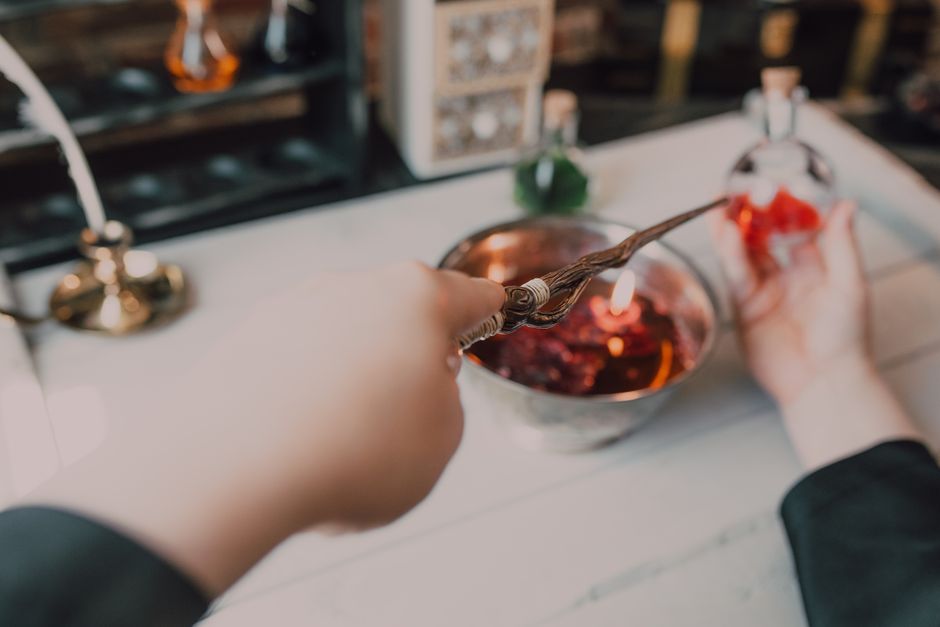
4Brew Your Ultimate Potion! 9 min
Challenge children to design and create their best 'spooky potion' using the knowledge gained. Encourage them to combine ingredients strategically to achieve desired effects (fizz, layers, color). Supervise for spills. Younger children can focus on fun mixing, older children on achieving specific, predicted outcomes. Done when they've created their 'ultimate' potion.
Know Before You Teach
- Good to know: This stage allows children to apply their observations and new understanding creatively.
- Encouraging experimentation with different ratios and orders of addition reinforces learning.
- If they ask: What if I mix everything? You can definitely try that! What do you predict will happen if you mix all the things you saw react?
- It's working when: Child making deliberate choices about ingredients based on previous observations, rather than random mixing.
- If they're stuck: Suggest they try to make the biggest fizz possible, or the potion with the most interesting layers.
- Easier: Help them choose two ingredients that you know will react strongly.
Done when: Children have created at least one 'ultimate' spooky potion demonstrating an understanding of how ingredients react.

5Potion Master Reflections 2 min
Lead a reflection on what they learned. Encourage them to articulate their favorite discoveries and connect them to real-world magic. Done when they share their favorite potion and a key takeaway. For younger children: 'What was your favorite potion to make?' For older children: 'What's one thing you'd tell a friend about chemical reactions after today?'
Know Before You Teach
- Good to know: Reflection helps consolidate learning and connect it to broader concepts.
- Connecting abstract concepts (reactions) to real-world applications or imaginative play deepens understanding.
- If they ask: Can I drink it? No, these are science potions for observing, not for drinking! We only taste things we know are safe food.
- It's working when: Child articulates one specific observation or concept they learned, beyond just 'it was fun'.
- If they're stuck: Ask: 'What was the most surprising thing your potion did?'
- Easier: Focus on their favorite part of making potions.
- Harder: Ask: 'Where else do you see 'chemical reactions' happening in our home, like when we cook or clean?'
Done when: Children share their favorite potion and one key takeaway about mixing ingredients or chemical reactions.
Beyond The Spark
Fuel their curiosity beyond the Spark with bonus extras.
Table Talk
Understanding how different substances react is essential for chefs who bake cakes (baking soda!), scientists who develop medicines, and even artists who mix paints.
Did You Know?
Did you know that the bubbles in soda pop are a gas called carbon dioxide, just like the gas you breathe out?
Challenge
Can you design a 'layered potion' where different liquids sit on top of each other without mixing, then add something to make a reaction happen in one of the layers?
Quick Recap Quiz 4 min
Customize this quiz, add questions, or follow your child's lead! Each question has a 'Parent Tip' to help them find the answer without giving it away.
1. What happens in a 'chemical reaction'?
- Two things mix and stay exactly the same.
- Two things mix and make something new, like bubbles.
Remind them about the fizzing potions and how new gas bubbles appeared.
2. Which combination is most likely to make your potion fizz?
- Water and oil
- Vinegar and baking soda
Recall which mixtures made lots of bubbles during their experiments.
3. If you mix oil and water, what happens?
- They mix perfectly to make one liquid.
- They stay in separate layers.
Ask them to remember their oil and water experiment and what they observed.
4. Why do scientists make predictions before an experiment?
- To guess what will happen and then see if they were right.
- To make sure the experiment always works perfectly.
Remind them that scientists learn from both correct and incorrect predictions.
Loved This Spark?
Scan to jump into the app and explore similar Sparks in our Sparks Hub. New to Mai? Start free with 10 Sparks, no credit card needed.