
How Do Bats See in the Dark?
Bats zoom through the night without crashing. How? Your child busts the "blind as a bat" myth, goes on an echo hunt around the house, and plays a Bat and Moth game to feel how bats find their way using sound.
Our goal: Children will understand that sound bounces back as an echo, and that many bats use those echoes to find their way and catch food in the dark. This is called echolocation.
What You Need
An open, clear space • Paper and crayons • A scarf or soft blindfold
and this is just the baseline.
Scan to jump into the app and easily personalize this Spark to match your child's exact learning level and see how Mai will guide this lesson.
Learning Guide
A simple guide to lead you through the kickoff, the core challenge, and everything in between.
Mai’s Tips
- Safe Bat Zone: Clear the floor before the game. The "bat" walks slowly with hands in front, and a grown-up stays close. Closed eyes work as well as a blindfold.
- Bust the Myth First: Many children (and grown-ups!) think bats are blind. Starting there makes the real answer exciting.
- Bats Are Friends: Many bats help by eating insects. Keep the tone curious, not creepy.
1Blind as a Bat? 4 min
Open the Spark by asking your child what they know about bats and how they might navigate in the dark. Let them share their initial ideas and discuss the common saying 'blind as a bat.'
Know Before You Teach
- Good to know: Bats are not blind. They can see, but many bats also use sound to find their way. This is called echolocation.
- If they ask: Then why do people say "blind as a bat"? It's an old saying that isn't true. Bats can see, and they have an extra superpower too.
- If they're stuck: Ask how they find their way when the lights are off.
- Easier: Yes or no: "Do you think bats can see?"
- Harder: Come up with two different ideas for how bats find their way.
Done when: Your child has guessed how bats find their way in the dark.

2Echo Hunt 5 min
Guide your child through different rooms in your house, experimenting with sounds and listening for echoes. Introduce the concepts of echo and echolocation as sounds that bounce back.
Know Before You Teach
- Good to know: An echo is sound that bounces off a surface and comes back. Hard surfaces bounce sound well; soft things soak it up.
- If they ask: Where does the sound go in the soft room? The pillows and rugs soak it up, so less bounces back.
- Key words: Echo: sound that bounces back
- Key words: Echolocation: finding things by listening to echoes
- Easier: Compare just two rooms, starting with the bathroom.
- Harder: Rank the rooms from most echo to least, and explain why.
Done when: Your child has found the room with the best echo.

3Bat and Moth Game 8 min
Set up a safe play area and explain the rules for the Bat and Moth game, which simulates echolocation. Emphasize safety and discuss how the game models a bat's use of sound to locate objects.
Know Before You Teach
- Good to know: Bats send out high sounds through their mouth or nose and listen to the echoes, which tell them the size, shape and even texture of what's around them.
- If they ask: Does the moth really talk back? No. The bat's own sound bounces off the moth, and the bat hears that echo. In our game, the moth's answer plays the echo.
- If they're stuck: The moth answers louder.
- Easier: The moth stays in one place.
- Harder: The moth takes one step after each answer.
Done when: Your child has played both the bat and the moth.
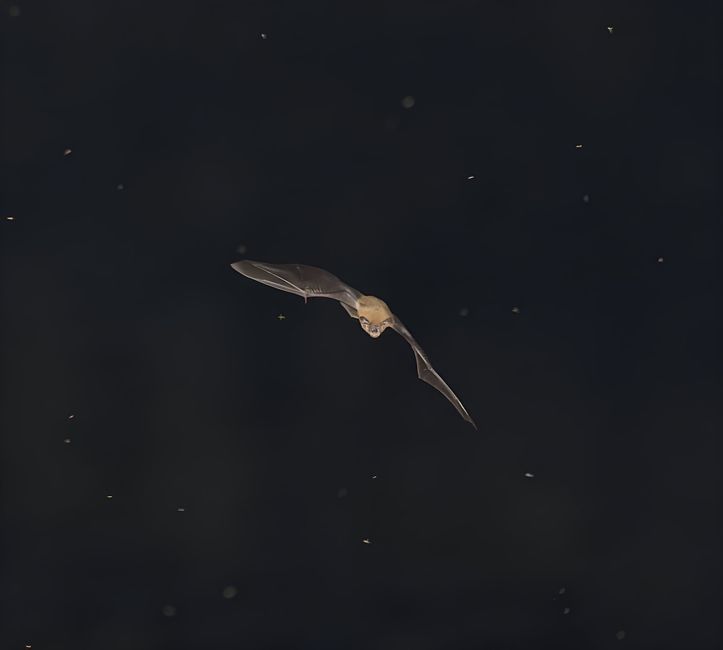
4Bat Sound Science 5 min
Explore the range of human hearing and compare it to the high-frequency sounds bats use. Discuss why we can't typically hear bat calls.
Know Before You Teach
- Good to know: People hear sounds up to about 20 kHz (less as we get older). Bat calls range from about 9 kHz to 200 kHz, so most bat echolocation is too high for us to hear. Scientists use special bat detectors to listen.
- If they ask: So bats are shouting and we can't hear them? Many of them, yes! The night is much noisier than we think.
- Easier: Just play with high and low sounds, like a deep drum and a tiny whistle.
- Harder: Why might a very high sound help a bat spot tiny insects?
Done when: Your child explains that most bat calls are too high for people to hear.

5Bat Fact Card 3 min
Guide your child in creating a 'Bat Fact Card' by drawing a bat and illustrating echolocation. Have them complete a sentence to explain what they've learned in their own words.
Know Before You Teach
- Easier: Draw the bat and say the sentence out loud.
- Harder: Label the "call" and the "echo."
Done when: Your child explains echolocation in their own words.
Beyond The Spark
Fuel their curiosity beyond the Spark with bonus extras.
Did You Know?
There are more than 1,500 kinds of bats. Many fruit bats don't use echolocation at all; they find fruit with their sharp eyes and noses.
Challenge
At dusk, go outside with a grown-up and look for bats swooping after insects. Watch from a distance, and never touch a bat.
Quick Recap Quiz 4 min
Customize this quiz, add questions, or follow your child's lead! Each question has a 'Parent Tip' to help them find the answer without giving it away.
1. Are bats blind?
- Yes
- No, they can see
Ask: "Which old saying about bats did we find out isn't true?"
2. What is an echo?
- Sound that bounces back
- A very quiet sound
Clap in the bathroom together: "What came back to us?"
3. How do many bats find food in the dark?
- By smelling the moon
- By listening to echoes
Ask: "In our game, how did the bat find the moth?"
4. Why can't we hear most bat calls?
- They're too high for our ears
- Bats whisper
Squeak as high as you can: "Are bat calls higher or lower than this?"
Loved This Spark?
Scan to jump into the app and explore similar Sparks in our Sparks Hub. New to Mai? Start free with 10 Sparks, no credit card needed.