
Enduring Glow Challenge
Discover the science behind keeping a flame burning with minimal resources, just like the story of Hanukkah. Design and build your own simple oil lamp, then observe how different materials affect its burn time. This activity requires adult supervision for handling open flames.
Our goal: Learners will understand the basic principles of how an oil lamp works by designing and building their own using everyday materials. They will investigate how different components affect burn time, connecting these scientific observations to the Hanukkah story's themes of resourcefulness and making the most of what you have.
What You Need
Vegetable oil • Small heat-safe containers • Cotton string • Aluminum foil • Scissors • Matches or lighter • Timer • Small tray or plate
and this is just the baseline.
Scan to jump into the app and easily personalize this Spark to match your child's exact learning level and see how Mai will guide this lesson.
Learning Guide
A simple guide to lead you through the kickoff, the core challenge, and everything in between.
Mai’s Tips
- Capillary Action: The core scientific concept here is how the wick draws oil. If it's not clicking, try a very simple demo: dip a corner of a paper towel into a small puddle of colored water and watch the water climb. Explain that the wick works the same way.
- Safety First: Open flames and hot oil require constant, direct adult supervision. Emphasize that this is an experiment, not a toy, and all fire handling is strictly for grown-ups.
- Simplify for Youngers: For younger children, focus on the observation of different wicks and the Hanukkah story connection. You can pre-assemble one lamp and just have them observe its burn, or let them pick materials while you do the assembly. Don't worry as much about deep scientific explanations of capillary action.
- Challenge Older Kids: For older children, introduce quantitative measurement. Have them measure the oil amount and wick length, and hypothesize relationships between these variables and burn time. You could even discuss surface tension's role in capillary action.
For The Grown-Up
- Watch out: Oil spills can be slippery and messy. Keep a tray underneath your work area and wipe up spills immediately with soap and water to prevent slips.
- Watch out: Ensure containers are fully heat-safe and placed on a non-flammable surface. Glass can crack if it gets too hot, especially thin glass.
- A common mix-up: Children might think that any string will work as a wick, or that a larger wick will always burn longer or brighter without considering its material properties.
- Try this: Encourage them to try different materials for wicks (e.g., tightly twisted paper towel vs. cotton string, or synthetic string if available for contrast). Let them observe which materials draw up oil most effectively and burn consistently, rather than correcting their initial assumptions.
- Explain it like this: The wick is like a tiny straw for the oil, drawing it up from the container to feed the flame.
- A big question to ask: Is a tiny flame from a small amount of oil, carefully tended, more powerful or impactful than a huge bonfire that burns out quickly?
Prep Before Session 5 min
- Cut cotton string into 6-inch (15 cm) lengths, enough for 2-3 lamps (or per child if they each make one).
- Tear or cut aluminum foil into small 2x2 inch (5x5 cm) squares.
- Ensure you have a small tray or heat-safe plate for the lamps to sit on during the activity.
1Introduction: The Festival of Lights 3 min
Begin by asking the child what they know about Hanukkah, the Festival of Lights, or any celebrations involving light. Introduce the idea of a small light that lasted surprisingly long. Gauge their initial curiosity about how light works.
Know Before You Teach
- Good to know: Hanukkah is also known as the Festival of Lights, celebrating a miracle where a small amount of oil for the Temple's menorah lasted for eight days.
- Many cultures use different types of lamps and lights for celebration or utility.
- If they ask: What is Hanukkah? It's a Jewish holiday celebrating religious freedom and a miracle of light that happened a long, long time ago.
- If they ask: What is a menorah? A special candle holder used during Hanukkah, usually with nine branches, one for each night and one to light the others.
- It's working when: Child expressing curiosity about how things burn or why lights are important.
- If they're stuck: Share a personal memory of a time you used light (camping, power outage) to spark their interest.
- Easier: Keep the intro very brief, focusing just on 'Festival of Lights' and the idea of light.
- Harder: Ask older children to research how different cultures use light in their traditions.
Done when: Student engages with the concept of light and fuel, and shows curiosity about how a flame stays lit.

2Explore & Plan: Designing Our Lamps 7 min
Lay out the vegetable oil, small containers, various cotton wick materials (string, cloth strip), aluminum foil, and scissors. Explain that they will be designing an oil lamp. Discuss what makes a good wick and have them make predictions.
Know Before You Teach
- Good to know: Different materials have different abilities to absorb and transport liquids.
- If they ask: Why can't I just light the oil directly? Oil itself doesn't burn easily in a puddle. It needs to be vaporized into a gas first, which the wick helps do by drawing a small amount up to the hot flame.
- If they ask: What if we just use a matchstick? A matchstick burns itself, it doesn't draw up fuel from the oil. It would burn out quickly.
- It's working when: Child identifying properties like absorbency or texture in the wick materials.
- If they're stuck: Suggest thinking about how a paper towel soaks up a spill, relating it to the wick needing to 'soak up' the oil.
- Easier: Limit the choices of wick materials to two very different ones for easier comparison.
- Harder: Ask older children to predict the chemical properties of a good wick material (e.g., porous, high surface area).
Done when: Student identifies potential wick materials, makes a prediction about burn time, and explains their reasoning.

3Discussion: The Secret of the Wick 6 min
Explain the science behind how a wick works. A wick draws liquid fuel up to the flame through capillary action. This is when a liquid moves up tiny spaces, like water climbing a paper towel or sap going up a tree. The oil is the fuel source, providing the energy for the flame. The wick needs to be made of a material that has lots of tiny pathways (like cotton) to draw up the fuel efficiently.
Know Before You Teach
- Good to know: Capillary action is the ability of a liquid to flow in narrow spaces without the help of, or even in opposition to, external forces like gravity.
- A fuel source is any material that stores energy and can be burned to produce heat or light.
- If they ask: Does water do capillary action? Yes! You can see it when water climbs up a paper towel or a thin tube.
- If they ask: Is food a fuel source? Yes, for our bodies! Our bodies 'burn' food to get energy, similar to how a lamp burns oil for light.
- It's working when: Child connecting the idea of 'drawing up' to the wick's function.
- Easier: Focus only on 'the wick drinks the oil' without using the term 'capillary action'.
- Harder: Ask older children what other forces (like surface tension, cohesion, adhesion) are involved in capillary action.
Done when: Student can explain capillary action and fuel source in simple terms, identifying them in the context of the oil lamp.
4Activity: Building and Testing Our Lasting Lights 10 min
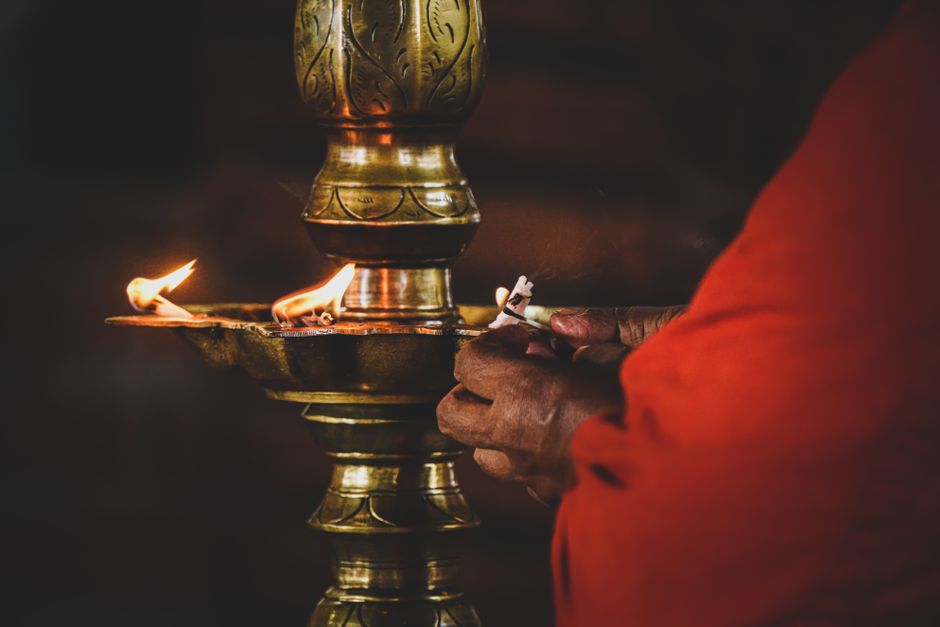
Guide the child in constructing their oil lamps. Help them cut wick materials and shape small pieces of aluminum foil to hold the wick upright in the container. Carefully pour oil into the containers, leaving some space at the top. Ensure the wicks are saturated with oil before lighting. Light the lamps (adult only) and start the timer, recording the burn time for each. Supervise closely.
Know Before You Teach
- Good to know: The wick must be fully saturated with oil to burn consistently.
- If they ask: Why is the flame so small? A small flame is enough to vaporize a tiny bit of oil at the top of the wick, and it conserves the oil to make it last longer.
- If they ask: Can I touch the flame? No, flames are very hot and can burn you. Only grown-ups handle the matches and light the lamps.
- It's working when: Child carefully handling materials and observing the initial flame.
- Easier: Have the child focus on helping pour the oil and placing the wick, while the adult handles cutting and lighting.
Done when: Student successfully constructs at least one oil lamp, safely lights it with adult supervision, and begins observing its burn time.

5Summary: The Miracle of Lasting Light 4 min
Discuss the results of the lamp experiment. Review which wicks burned longest and why. Connect this observation to the Hanukkah story of the oil lasting eight days. Emphasize the themes of resourcefulness and making the most of what you have. Ask reflective questions.
Know Before You Teach
- Good to know: The Hanukkah story highlights resourcefulness and resilience.
- Observations from the experiment directly demonstrate how materials and design can extend the life of a fuel source.
- If they ask: Was it a real miracle? For many, the oil lasting was a miracle from God. For others, it's a powerful story that teaches us about hope and making the most of what we have, even when things are difficult.
- If they ask: Can we make a giant oil lamp? Yes, people have made very large oil lamps! But the principles of the wick and fuel remain the same, just on a larger scale.
- It's working when: Child connecting their experimental results to the concept of 'lasting light' or 'resourcefulness'.
- If they're stuck: Remind them of their initial predictions and ask if the results matched them, prompting for 'why not' or 'why so'.
- Easier: Focus only on 'What was your favorite part?' and 'What did you see happen?'
- Harder: Ask older children to brainstorm other historical or modern examples of resourcefulness where a small amount of something was made to last a long time.
Done when: Student shares an observation from the activity and reflects on the connection to the Hanukkah story or the concept of making resources last.
Beyond The Spark
Fuel their curiosity beyond the Spark with bonus extras.
Table Talk
Understanding fuel sources and efficient combustion is crucial for engineers designing everything from rockets to eco-friendly stoves.
Did You Know?
Some ancient oil lamps were shaped like animals or tiny boats!
Challenge
Can you design a wick holder that automatically adjusts its height as the oil level drops?
Quick Recap Quiz 4 min
Customize this quiz, add questions, or follow your child's lead! Each question has a 'Parent Tip' to help them find the answer without giving it away.
1. What is the main job of a wick in an oil lamp?
- To hold the oil in place
- To draw oil up to the flame
Remind them of the 'thirsty plant stem' or 'straw' analogy for capillary action.
2. What is the 'fuel source' in our oil lamp?
- The oil
- The container
Ask what actually burns to create the light and heat.
3. Why is cotton string usually better than plastic string for a wick?
- Plastic is too colorful
- Cotton has tiny spaces for capillary action
Focus on the material's ability to absorb and transport liquid.
4. How does this experiment connect to the Hanukkah story?
- It shows how a small amount of oil can last surprisingly long
- It teaches us how to make new types of oil
Recall the story of the one-day oil lasting eight days.
Loved This Spark?
Scan to jump into the app and explore similar Sparks in our Sparks Hub. New to Mai? Start free with 10 Sparks, no credit card needed.