Cookie Count Challenge!
A fun, button-based multiplication game inspired by your favorite kitchen treats. Introduces basic multiplication as a quick way to count equal groups. The student explores how multiplication is repeated addition through a hands-on cookie-baking scenario using common kitchen items.
Our goal: In this spark, your learner will identify equal groups in a given set, express repeated addition situations as multiplication equations and use concrete objects to model basic multiplication problems up to 10.
What You Need
Buttons • Index Cards • Markers • Paper • colorful buttons
and this is just the baseline.
Scan to jump into the app and easily personalize this Spark to match your child's exact learning level and see how Mai will guide this lesson.
Learning Guide
A simple guide to lead you through the kickoff, the core challenge, and everything in between.
Mai’s Tips
- Make it Delicious: Want to scale this lesson up? Take it to the kitchen! Bake a fresh batch of real cookies together. Before eating, arrange the cookies in equal rows on the baking sheet and use the exact same grouping method to practice multiplication. Connecting abstract numbers to real-life baking makes concepts stick forever.
- Let Them Lead: If your child gets stuck, don't rush to give the answer. Let them manually recount the physical buttons as many times as they need. Independent problem-solving builds massive learning confidence.
Prep Before Session 5 min
- Gather 3 index cards.
- Gather at least 20 small buttons or similar uniform small items.
- Find a blank piece of paper and a pen or pencil.
- Clear a flat workspace for the activity.
1Introduction 3 min
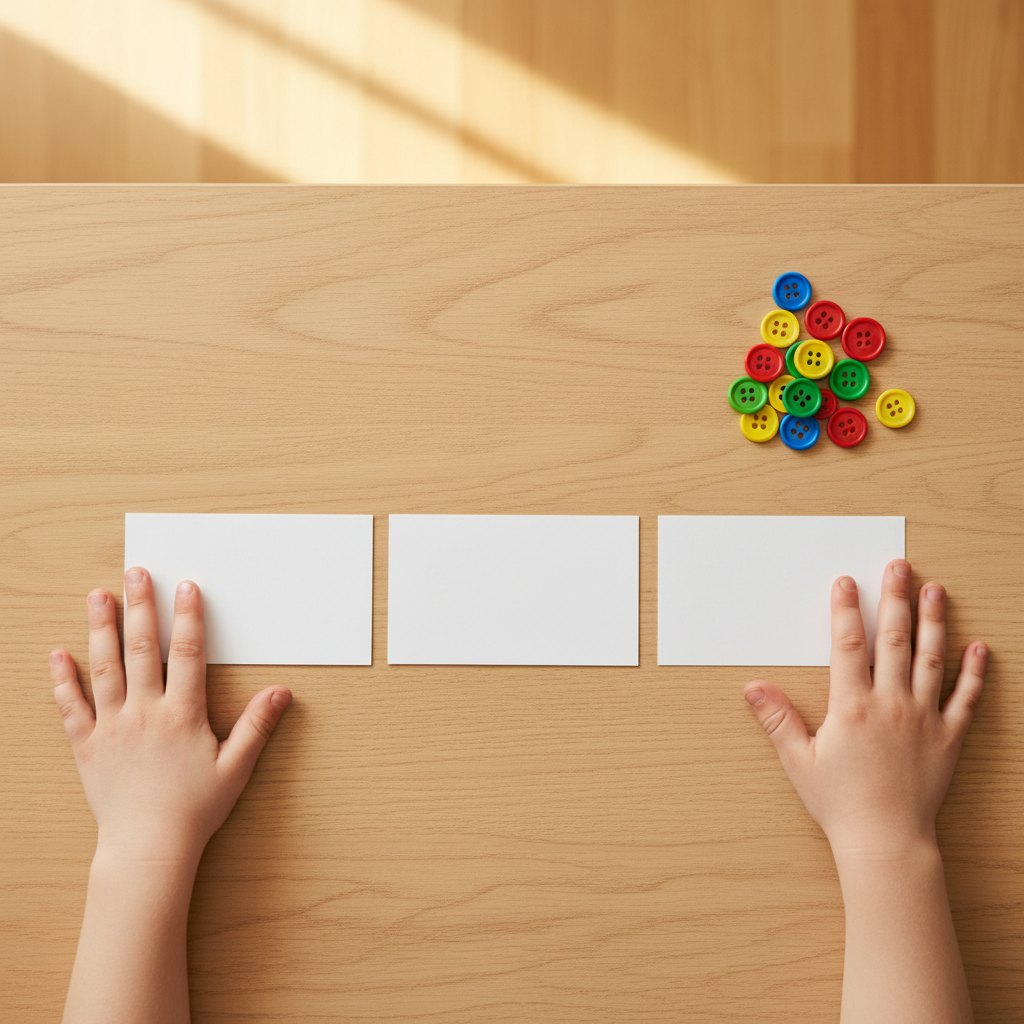
Lay out three index cards in a row in front of your child. Hand them the pile of buttons. Explain these cards are our "magic baking sheets" and the buttons are our "cookies." Ask, "Have you ever helped bake something at home, or made a pattern with your art supplies?" Encourage them to share their experiences. This helps them connect the activity to their own world and build excitement for discovering a "secret" counting method. Done when a clear workspace is set up and your child is engaged and curious about the counting trick.
Know Before You Teach
- Good to know: Multiplication is a fast way to count things that are arranged in equal groups.
- The 'secret' counting method we're going to explore is multiplication, which saves time compared to counting every single item.
- Using hands-on items like buttons and cards makes abstract math concepts like multiplication more concrete for young children.
- It's working when: The child shows curiosity, perhaps by asking a question, making eye contact, or reaching for the buttons.
- If they're stuck: Ask about another familiar activity, like 'Have you ever built something with blocks or played with toys that come in sets?'
- Easier: Place one button on a card and say, 'Here's one cookie on our magic baking sheet,' to start the example for them.
- Harder: Ask the child to predict what kind of 'secret trick' might exist for counting things faster.
Done when: A clear visual workspace is established and the child is engaged and curious about the counting trick.

2Visual Learning 8 min
Have your child place exactly 4 buttons onto each index card, counting out loud as they place each one down. Point out the visual arrangement. Explain that these are "equal groups" because each card, or group, has the exact same number of cookies. Ask, "How many cookies are in each row?" Then ask, "How many rows do you see?" Focus on their concrete counting and observing that the numbers are identical across the trays. Done when each card holds exactly 4 buttons and your child can state that every tray has the same amount.
Know Before You Teach
- Good to know: Visually seeing groups of four cookies on each card helps connect the abstract idea of a number to a physical quantity.
- The number 4 in this step is specific to this lesson to build the example of 3 groups of 4.
- If they ask: Why do all the cards have to have the same number of cookies? Because our secret counting trick only works when all the groups are perfectly fair and have the exact same amount.
- Easier: Place the 4 buttons on the first card yourself, counting aloud, and then have the child do the next two cards.
- Harder: After they place the buttons, ask them to close their eyes and then point to a card and ask, 'How many cookies are on this card without looking?'
Done when: Each card holds exactly 4 buttons and the child can state that every tray has the same amount.

3Discussion 4 min
Ask your child, "How many cookies did we bake in total?" Guide them to point to each card and count by groups: "4, then 4 more, then 4 more." Explain this is called "repeated addition" because you are adding the same number multiple times. Ask, "Do you think there might be an even faster way to say that, instead of adding every single time?" Affirm their answer if they suggest addition, but gently nudge towards a quicker method. Done when your child can express the total as repeated addition (4 + 4 + 4) in their own words.
Know Before You Teach
- It's working when: The child accurately states the total number of buttons is 12, even if they count them individually first.
- If they're stuck: Help them count each group, saying '4 cookies here, and 4 more make 8, and 4 more make 12 altogether.'
Done when: The child can express the total as repeated addition (4 + 4 + 4) in their own words.
4Activity 6 min
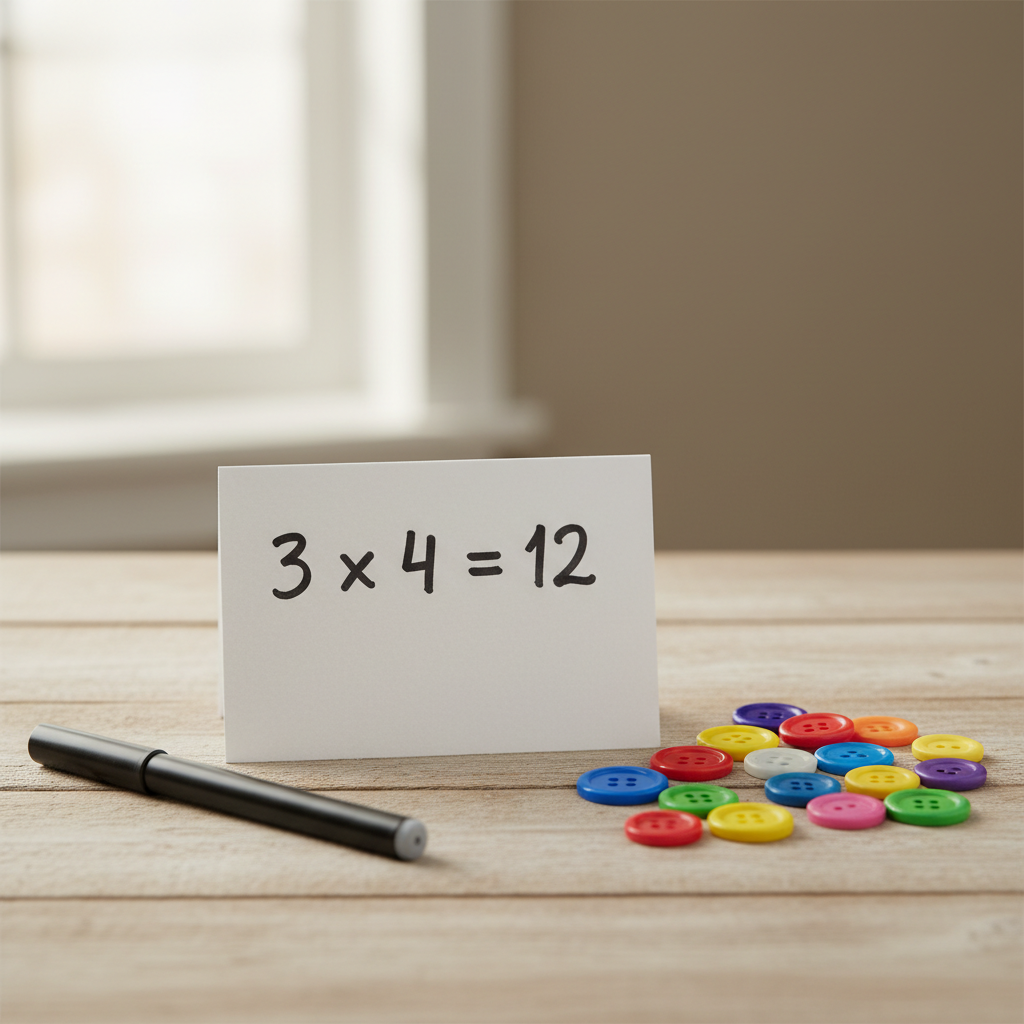
Explain that instead of adding 4 + 4 + 4, we can say we have "3 groups of 4." This "groups of" is a faster way to count, and mathematicians call it "multiplication," using the "x" symbol which means "times." Write "3 x 4 = 12" on a piece of paper. Let your child do the writing if they are able, as ownership matters more than neatness. Have them gather all 12 buttons and line them up right next to the written equation, so they can visually see that the answer matches the total number of "cookies." Done when your child has written 3 x 4 = 12 and matched it to 12 physical buttons.
Know Before You Teach
- Good to know: The phrase '3 groups of 4' directly translates to the multiplication equation 3 x 4.
- If they ask: Why is it called 'times'? It's like saying 'three different times you have a group of four,' so '3 times 4' is another way to say '3 groups of 4.'
- Key words: Groups of: Having several sets where each set has the same amount, like '3 groups of 4 cookies.'
- If they're stuck: Write '3 x 4 = 12' yourself and then guide their finger to trace the numbers and symbols.
Done when: The child has written 3 x 4 = 12 and matched it to 12 physical buttons.

5Summary 2 min
Celebrate your child's accomplishment, acknowledging that they just used real multiplication like a mathematician. Connect this new skill to real-world scenarios. Explain that "equal groups" are everywhere once you start looking for them, such as in art patterns, on sports teams, or when setting a table for a party. Ask, "What is one place you think you might spot equal groups today?" Emphasize their growth in understanding a new mathematical concept. Done when your child reflects on what they learned and can state one key takeaway about multiplication or equal groups.
Know Before You Teach
- Good to know: Multiplication is a foundational math skill that helps solve problems involving equal groups in many different situations.
- Thinking about how math applies to everyday life helps children see its relevance and importance.
- If they ask: Where else can I find equal groups? Think about things that come in pairs, like socks or shoes, or how many wheels are on a few toy cars – those are all equal groups!
- It's working when: The child offers an example of equal groups from their daily life, or points to something in the room that forms equal groups.
- If they're stuck: Give an example and ask, 'Do you think the legs on our kitchen chairs are equal groups?'
- Easier: Provide two clear examples, like 'The eggs in a carton' or 'fingers on two hands,' and ask them to pick one they understand.
- Harder: Ask them to imagine a scenario and explain how they would use multiplication to count something in it, like 'How would you count all the windows on three different houses?'
Done when: The child reflects on what they learned, answers all 4 recap questions, and can state one key takeaway.
Beyond The Spark
Fuel their curiosity beyond the Spark with bonus extras.
Did You Know?
Some ancient civilizations, like the Babylonians, used multiplication tables over 4,000 years ago - before calculators - to build structures and track goods.
Challenge
Become a "Pattern Detective"! Find patterns or equal-group arrangements around your home (floor tiles, windows, art supplies). Draw them and write the multiplication equation for each.
Quick Recap Quiz 4 min
Customize this quiz, add questions, or follow your child's lead! Each question has a 'Parent Tip' to help them find the answer without giving it away.
1. What does "equal groups" mean?
- Groups are different
- Groups are the same
Remind your child of the cookie trays - each tray must have the exact same number of cookies.
2. How can you write 3 + 3 + 3 using multiplication?
- 3 x 2
- 3 x 3
Ask your child to count how many times the number 3 is repeated.
3. If you have 2 groups of 5, what is the total?
- 7
- 10
Encourage your child to think of 5 + 5, or visualize 2 sets of 5 items.
4. Multiplication is a fast way to do what?
- Subtraction
- Repeated addition
Recall our discussion about counting a large batch of cookies much faster.
Loved This Spark?
Scan to jump into the app and explore similar Sparks in our Sparks Hub. New to Mai? Start free with 10 Sparks, no credit card needed.