
Become a Super Sorter!
This lesson challenges young learners to sort a mixed collection of everyday objects. They will discover different ways to group items, building early math skills and organization.
Our goal: In this spark, your learner will identify different attributes of objects (color, size, shape, use), sort objects into distinct categories based on chosen attributes and explain the reasoning behind their sorting choices.
What You Need
Mixed Toys • Small Containers • Mat/Table
and this is just the baseline.
Scan to jump into the app and easily personalize this Spark to match your child's exact learning level and see how Mai will guide this lesson.
Learning Guide
A simple guide to lead you through the kickoff, the core challenge, and everything in between.
Mai’s Tips
- Encourage your child to lead the sorting criteria. Even if it's not what you expected, celebrate their reasoning and ask 'Why did you choose to group them that way?'
- If your child gets stuck, offer a 'thinking aloud' prompt like, 'I wonder if we could put all the ____ together?' instead of directly suggesting a category.
Prep Before Session 10 min
- Gather 15-20 mixed everyday objects: toys, kitchen items, small blocks, craft supplies. Ensure a variety of colors, sizes, shapes, and textures.
- Find 3-5 small, empty containers (bowls, cups, shoebox lids) for sorting.
1Introduction 5 min
Place the pile of mixed items on your mat or table. Let your child freely observe and touch them. Ask them to describe what they see: "What do you see here?" or "What kind of things are these?" Introduce the concept of 'sorting.' Explain that 'sorting' means putting things into groups based on how they are alike, for example, putting all the red blocks together. This helps keep things tidy and organized. Ask: "What do you think 'sorting' means?"
Done when your child shows interest in the items and can offer a basic understanding of 'putting things together' or 'making groups.'
Know Before You Teach
- Good to know: Sorting helps us find things easily and understand how things are related.
- Young children often start sorting by color or type of object.
- If they ask: What are all these things for? These are just some things from around the house that we can look at closely.
- If they ask: Why do we need to put them in groups? It helps us keep things neat and know where everything belongs.
- It's working when: Child picking up and holding different items, pointing to things.
- If they're stuck: Gently pick up an item and say, 'I wonder what this is made of?' to model curiosity.
- Easier: Use a smaller collection of 5-7 items that have very obvious differences.
- Harder: Ask the child to find two items that are exactly the same.
Done when: Child shows interest in the items and can articulate a basic understanding of 'putting things together' or 'making groups'.
2Explore & Plan 8 min
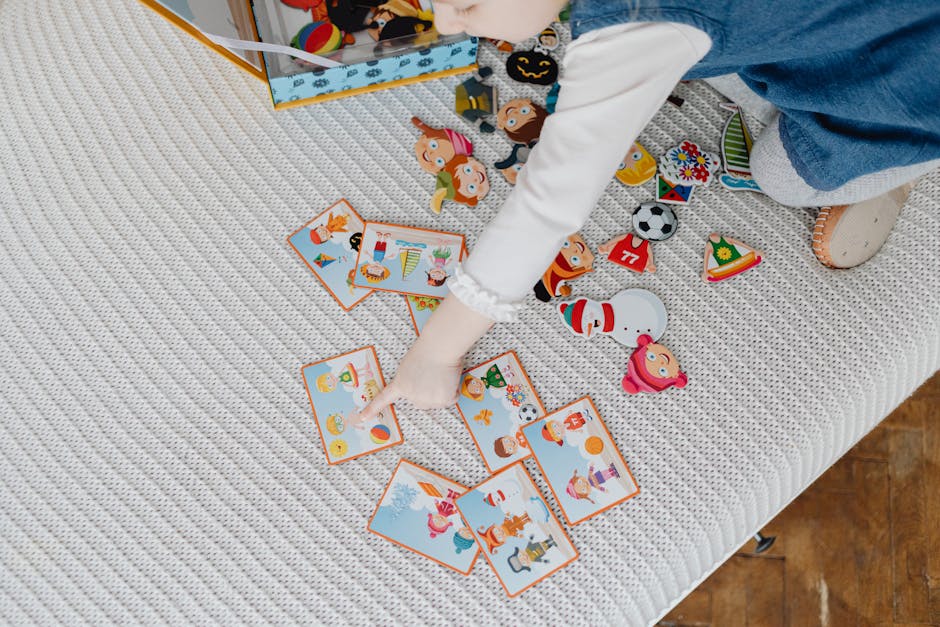
Encourage your child to pick up and manipulate individual items from the pile. Guide them to think about different characteristics, called 'attributes.' An 'attribute' is a quality like color, size, shape, or texture that describes something. Attributes are how things are alike or different. Ask: "Tell me about this one." or "What color is this? Is it soft or hard?"
Then, step back and ask them about the whole collection: "What are some things you notice about them?" and "Do some of them look the same in some ways? Do some look different? How could we start putting them into groups?"
Done when your child has identified at least two different observable attributes of the objects (e.g., 'red,' 'small,' 'bumpy,' 'toy car').
Know Before You Teach
- Good to know: Attributes are the specific details we use to describe an object, like its color or how big it is.
- Observing attributes is the first step before deciding how to sort.
- It's working when: Child using descriptive words like 'red,' 'bumpy,' or 'small' when talking about items.
- If they're stuck: Point to an item and provide a descriptive word, like 'This block is square.'
- Easier: Focus only on color: 'What colors do you see here?'
- Harder: Ask them to compare two items and describe how they are both alike and different.
Done when: Child has identified at least two different observable attributes of the objects (e.g., 'red,' 'small,' 'bumpy,' 'toy car').

3Discussion 6 min
Reiterate your child's previous observations. For example, if they noticed red and blue items, say: "You said some are red and some are blue. If we wanted to put all the red things together, what would that group be called?" Guide them to articulate potential 'categories.' A 'category' is a type of group you make when you sort things, like a 'color category' for all the red toys.
Ask them: "How is that different from putting all the 'toy cars' together?" or "What other groups could we make with these?"
Done when your child can suggest at least one logical way to sort the objects (e.g., 'by color,' 'by kind of toy,' or 'big ones and small ones').
Know Before You Teach
- Good to know: A category is a specific group of items that share a common attribute.
- There can be many different ways to categorize the same collection of objects.
- If they ask: What's a category? It's like a special name for a group of things that are alike, such as a 'group of all the red toys'.
- If they ask: Can things be in more than one group? Yes, a red car could be in the 'red things' group and also in the 'toy cars' group.
- It's working when: Child suggesting a coherent group, like 'all the smooth ones' or 'things to play with'.
- Easier: Ask yes/no questions about categories: 'Could we make a group of just the soft things?'
- Harder: Ask the child to think of a category that uses two attributes, like 'Can you make a group of red and soft things?'
Done when: Child can suggest at least one logical way to sort the objects (e.g., 'by color,' 'by kind of toy,' or 'big ones and small ones').

4Activity 9 min
Provide the mixed items and several small containers (bowls, cups, or plates) on a mat or table. Let your child choose their sorting criteria first. Ask them: "Will you sort them by color? By what they are? By how big they are? Pick your favorite way!"
Encourage them to explain their choices as they sort, asking: "Show me how you'd put them together!" and "Why did you choose to group them that way?"
If they finish sorting one way, extend the activity by asking: "Can you sort them another way?"
Done when your child has successfully sorted the pile of objects into at least two distinct groups based on a chosen attribute.
Know Before You Teach
- Good to know: Children learn best by doing and making their own choices about how to sort.
- There is no single 'right' way to sort; many different sorting rules can be correct.
- If they ask: Which way is the best way to sort? The best way is the one that makes sense to you and helps you keep things organized.
- If they ask: What if I make a mistake? There are no mistakes in sorting, only different ways to put things together.
- It's working when: Child purposefully placing items into containers or areas according to their chosen rule.
- If they're stuck: Start sorting two or three items yourself based on an obvious attribute, and ask 'What am I doing here?'
- Easier: Provide containers labeled with a specific attribute (e.g., a red circle sticker on one, a blue on another).
- Harder: Ask them to sort all the items, then mix them up and sort them again using a completely different rule.
Done when: Student has successfully sorted the pile of objects into at least two distinct groups based on a chosen attribute.

5Summary 2 min
Celebrate your child's accomplishment enthusiastically! Point out how organized everything looks now. Briefly review the different ways they sorted the items. Ask them: "How did it feel to be a Super Sorter?" and "What was your favorite way to put things together?"
Connect the act of sorting to real-life examples: "Why do you think sorting things is helpful in real life, like with laundry or groceries?"
Done when your child shares one key takeaway, an observation, or something they enjoyed about the sorting activity.
Know Before You Teach
- If they ask: Can we sort my toys later? Yes, we can use our super sorting skills to organize your toy box!
- It's working when: Child making a connection between sorting and a real-world task or expressing pride.
- If they're stuck: Offer a specific example: 'Remember when we put all the shirts together in the laundry?'
- Easier: Focus on asking 'What was the most fun part about sorting?'
- Harder: Ask them to explain to you, as if you don't know, how they would sort a new pile of items.
Done when: Student shares one key takeaway, an observation, or something they enjoyed about the sorting activity.
Beyond The Spark
Fuel their curiosity beyond the Spark with bonus extras.
Table Talk
Scientists sort animals and plants to understand the world better, just like you sorted your toys!
Challenge
Try sorting your snack! Can you sort your fruit pieces from your crackers? Or maybe sort your blocks by shape AND color!
Quick Recap Quiz 4 min
Customize this quiz, add questions, or follow your child's lead! Each question has a 'Parent Tip' to help them find the answer without giving it away.
1. What does it mean to 'sort' things?
- Throw everything away
- Put things into groups
Remind them of the organized groups they made.
2. What can we sort things by?
- How they look or feel
- Only their names
Think about how they sorted their toys – by color, size, or type.
3. If you put all your red blocks together, what are you sorting by?
- Their size
- Their color
What do all those blocks have in common?
4. Why is sorting things helpful?
- It makes things easier to find
- It makes more mess
Imagine trying to find a specific toy in a giant messy pile versus a neat box.
Loved This Spark?
Scan to jump into the app and explore similar Sparks in our Sparks Hub. New to Mai? Start free with 10 Sparks, no credit card needed.